


Page 12 - The CoESPU Magazine N 1 - 2018
P. 12
Information concerning  international crimes is not only  relevant for the  aforementioned criminal
            courts and tribunals, but also for other transitional justice mechanisms.
            One example of these are truth commissions, such as those established in South Africa after the end
            of the apartheid era, in East Timor and Sierra Leone.
            Other such mechanisms are compensation and property claims commissions. In addition, a variety
            of  international  judicial,  quasi-judicial  and  supervisory  bodies  exist  for  whom  information  on
            international crimes may be relevant. These bodies may include:
             ·  the International Court of Justice;
             ·  arbitration panels;
             ·  international and national commissions of inquiry;

             ·  compensation commissions;
             ·  human rights bodies, such as the UN Human Rights Council and its special rapporteurs and
                 working groups;
             ·  the UN Human Rights Committee;
             ·  regional human rights courts and commissions (European, Inter-American and African).
            But, every national or international judicial system is powerless without the support of an effective
            law enforcement system.
            In  this  context,  the  mission  of  the  UN  Police  is  to  enhance  international  peace  and  security  by
            supporting member states in conflict, post-conflict and other crisis situations to realize effective,
            efficient,  representative,  responsive  and  accountable  police  services  that  serve  and  protect  the
            population. To that end, UN Police build and support, or, where mandated, act as a substitute or
            partial substitute for, host-state police capacity to prevent and detect crime, protect life and property
            and maintain public order and safety in adherence to the rule of law and international human rights
            law.


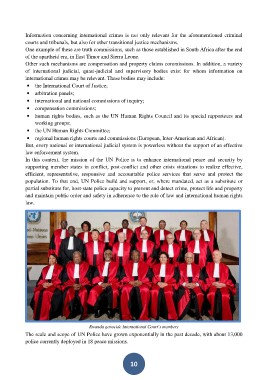
                                         Rwanda genocide International Court’s members
            The scale and scope of UN Police have grown exponentially in the past decade, with about 13,000
            police currently deployed in 18 peace missions.


                                                           10

