


Page 13 - The CoESPU Magazine N 1 - 2018
P. 13
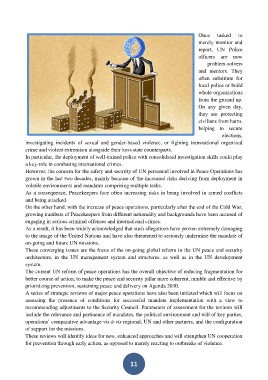
Once    tasked    to
                                                                                         merely monitor and
                                                                                         report,  UN  Police
                                                                                         officers  are  now
                                                                                             problem-solvers
                                                                                         and  mentors.  They
                                                                                         often  substitute  for
                                                                                         local police or build
                                                                                         whole organizations
                                                                                         from the ground up.
                                                                                         On  any  given  day,
                                                                                         they  are  protecting
                                                                                         civilians from harm,
                                                                                         helping  to  secure
                                                                                                    elections,
            investigating  incidents  of  sexual  and  gender-based  violence,  or  fighting  transnational  organized
            crime and violent extremism alongside their host-state counterparts.
            In particular, the deployment of well-trained police with consolidated investigation skills could play
            a key-role in combating international crimes.
            However, the concern for the safety and security of UN personnel involved in Peace Operations has
            grown in the last two decades, mainly because of the increased risks deriving from deployment in
            volatile environments and mandates comprising multiple tasks.
            As a consequence, Peacekeepers face often increasing risks in being involved in armed conflicts
            and being attacked.
            On the other hand, with the increase of peace operations, particularly after the end of the Cold War,
            growing numbers of Peacekeepers from different nationality and backgrounds have been accused of
            engaging in serious criminal offenses and international crimes.
            As a result, it has been widely acknowledged that such allegations have proven extremely damaging
            to the image of the United Nations and have also threatened to seriously undermine the mandate of
            on-going and future UN missions.
            These converging issues are the focus of the on-going global reform in the UN peace and security
            architecture,  in  the  UN  management  system  and  structures,  as  well  as  in  the  UN  development
            system.
            The current UN reform of peace operations has the overall objective of reducing fragmentation for
            better course of action, to make the peace and security pillar more coherent, nimble and effective by
            prioritizing prevention, sustaining peace and delivery on Agenda 2030.
            A series of strategic reviews of major peace operations have also been initiated which will focus on
            assessing  the  presence  of  conditions  for  successful  mandate  implementation  with  a  view  to
            recommending adjustments to the Security Council. Parameters of assessment for the reviews will
            include the relevance and pertinence of mandates, the political environment and will of key parties,
            operations’ comparative advantage vis-à-vis regional, UN and other partners, and the configuration
            of support for the missions.
            These reviews will identify ideas for new, enhanced approaches and will strengthen UN cooperation
            for prevention through early action, as opposed to merely reacting to outbreaks of violence.


                                                           11

