


Page 15 - The CoESPU Magazine N 1 - 2018
P. 15
How to transform a Police Force and Criminal Justice System

                                      that are part of the problem


                 One  of  the  most  detrimental  gaps  impeding  the  international  community  when  it  seeks  to
          stabilize a state ravaged by internal conflict, is the absence of authoritative guidance on how to deal with
          indigenous police  and criminal justice systems that provide impunity for political elites who obstruct
          peace implementation. Spoilers who thwart the implementation of a mandate from the United Nations or
          another mandating authority, commit an international crime that imperils the very purpose of peace and
                                                      stability  operations.  The  existence  of  this  knowledge  or
                                                      “doctrinal” gap is manifested in the 2015 Department of
                                                      Peacekeeping  Operations  (DPKO)  “Guidelines:  Police
                                                      Capacity-building and Development” which states:
                                                      These  Guidelines  are  based  on  the  assumption  that  the
                                                      host  State  government  is  committed  to  the  objective  of
                                                      good  and  democratic  governance,  including  the
                                                      establishment  of  a  responsive,  representative  and
                                                                                  i
                                                      accountable police service…
                                                      This assumption, when fallacious, can doom a mission to
                                                      frozen conflicts at best and near collapse of the mission at
                                                      worst (e.g. Rwanda, Bosnia, Kosovo, Sierra Leone, Haiti,
                                                      Democratic Republic of the Congo, and South Sudan). In
                                                      spite  of  the  potentially  calamitous  risks  associated  with
                                                      basing missions on this best case assumption, DPKO has
          no  methodology  to  test  whether  this  dubious  assumption  holds  true  or  not.  The  DPKO  Integrated
          Assessment  and  Planning  Handbook  promulgated  in  December  2013  acknowledges  that  “there  is  no
          agreed  United  Nations  system-wide  methodology  for  comprehensively  assessing  risks  to  the  United
          Nations  in  post-conflict  and
                            ii
          conflict  settings.”   Thus  the
          UN’s  approach  to  capacity
          building  is  based  on  an
          assumption-- that the host State
          government  is  committed  to
          the  objective  of  good  and
          democratic governance—that it
          has    not     developed     a
          methodology for assessing.
          Unfortunately, this assumption
          is  rarely  valid.  Over  70%  of
          the  UN’s  post-1990  missions
          have  been  confounded  by
          spoilers  in  the  form  of
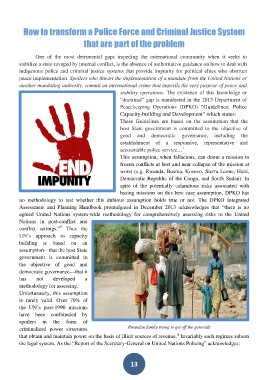
          criminalized  power  structures                 Rwandan family trying to get off the genocide
                                                                                iii
          that obtain and maintain power on the basis of illicit sources of revenue.  Invariably such regimes suborn
          the legal system. As the “Report of the Secretary-General on United Nations Policing” acknowledges:


                                                           13

