


Page 7 - The CoESPU Magazine N 1 - 2018
P. 7
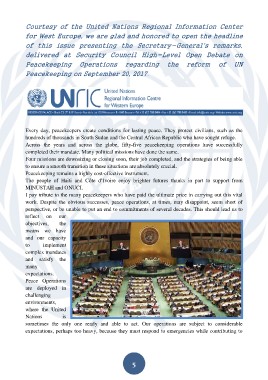
Courtesy  of  the  United  Nations  Regional  Information  Center

            for West Europe, we are glad and honored to open the headline

            of  this  issue  presenting  the  Secretary-General's  remarks,
            delivered  at  Security  Council  High-Level  Open  Debate  on

            Peacekeeping  Operations  regarding  the  reform  of  UN

            Peacekeeping on September 20, 2017.


            Every  day,  peacekeepers  create  conditions  for  lasting  peace.  They  protect  civilians,  such  as  the
            hundreds of thousands in South Sudan and the Central African Republic who have sought refuge.
            Across  the  years  and  across  the  globe,  fifty-five  peacekeeping  operations  have  successfully
            completed their mandate. Many political missions have done the same.
            Four missions are downsizing or closing soon, their job completed, and the strategies of being able
            to ensure a smooth transition in these situations are absolutely crucial.
            Peacekeeping remains a highly cost-effective instrument.
            The  people  of  Haiti  and  Côte  d’Ivoire  enjoy  brighter  futures  thanks  in  part  to  support  from
            MINUSTAH and ONUCI.
            I pay tribute to the many peacekeepers who have paid the ultimate price in carrying out this vital
            work.  Despite  the  obvious  successes,  peace  operations,  at  times,  may  disappoint,  seem  short  of
            perspective, or be unable to put an end to commitments of several decades. This should lead us to
            reflect   on   our
            objectives,    the
            means  we  have
            and  our  capacity
            to      implement
            complex mandates
            and  satisfy  the
            many
            expectations.
            Peace  Operations
            are  deployed  in
            challenging
            environments,
            where  the  United
            Nations          is
            sometimes  the  only  one  ready  and  able  to  act.  Our  operations  are  subject  to  considerable
            expectations, perhaps too heavy, because they must respond to emergencies while contributing to


                                                            5

