


Page 71 - Coespu 2020-2
P. 71
tients, suggesting that delirium was  small sample this diagnosis appe-  bility,  irritability,  pressured spe-
    common. Other common psychia-       ared to be almost entirely related   ech, and euphoria were relati-
    tric  fi ndings  were  depression,  to use of exogenous corticoste-      vely  common,  suggesting that
    anxiety, and insomnia. Diagnoses  roids, which are rarely prescribed    although a full syndrome of mania
    of mania and psychosis did occur  to treat SARS-CoV-2 infection.        was uncommon, not  detectable
    in a small minority (0·7%), but in a  Notably, insomnia, emotional la-  symptoms might  be present.
                                                                            In SARS and MERS, after recovery
                                                                            from the infection, sleep disorder,
                                                                            frequent recall of traumatic me-
                                                                            mories,  emotional lability, impai-
                                                                            red concentration, fatigue, and
                                                                            impaired memory were reported
                                                                            in more than 15% of patients at a
                                                                            follow-up period ranging between
                                                                            6 weeks and 39 months. Emotio-
                                                                            nal lability, pressured speech, and
                                                                            euphoria  were only reported  by
                                                                            patients and relatives after a short
                                                                            follow-up  in one studying  whi-
                                                                            ch corticosteroids had  frequent-
                                                                            ly been prescribed at  high doses
                                                                            and  symptoms; therefore, it mi-
                                                                            ght be of limited relevance to the
                                                                            COVID-19 pandemic.  The point
                                                                            prevalences  of anxiety disorders,
                                                                            depression,  and post-traumatic
                                                                            stress disorder were high, although
                                                                            the lack of  adequate  comparison
                                                                            groups or assessment of previous
                                                                            psychiatric  disorder means that it
                                                                            is hard  to  separate  the effects of
                                                                            the infection from the impact  of
                                                                            an epidemic  on the population.
                                                                            In terms of severity, mean sco-
                                                                            res for depression and anxiety on
                                                                            standard scales were below clini-
                                                                            cal cutoffs. Measures of health-re-
                                                                            lated quality of life were conside-
                                                                            rably  lower in patients with SARS
                                                                            than  in  control  groups.  However,
                                                                            the impairment in  social  functio-
                                                                            ning was greater than the effects
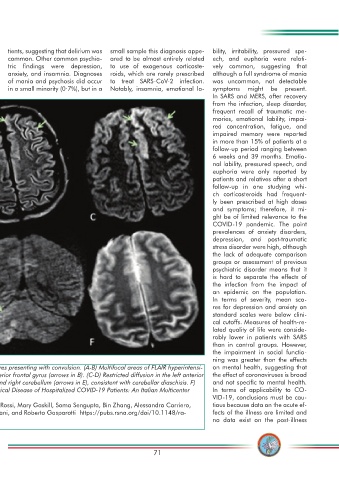
 Image 2. Acute encephalopathy. A 60 year-old-man without history of seizures presenting with convulsion. (A-B) Multifocal areas of FLAIR hyperintensi-  on mental health, suggesting that
 ty in the right cerebellum (arrows in A), left anterior cingular cortex and superior frontal gyrus (arrows in B). (C-D) Restricted diffusion in the left anterior   the effect of coronaviruses is broad
 cingulate cortex, superior frontal and middle temporal gyrus (arrows in D) and right cerebellum (arrows in E), consistent with cerebellar diaschisis. F)   and not specifi c to mental health.
 No hemosiderin deposits in Gradient echo sequences. (Imaging in Neurological Disease of Hospitalized COVID-19 Patients: An Italian Multicenter   In terms of applicability to CO-
 Retrospective Observational Study                                          VID-19, conclusions must be cau-
 Abdelkader Mahammedi, Luca Saba, Achala Vagal, Michela Leali, Andrea Rossi, Mary Gaskill, Soma Sengupta, Bin Zhang, Alessandro Carriero,   tious because data on the acute ef-
 Suha Bachir, Paola Crivelli, Alessio Paschè, Enrico Premi, Alessandro Padovani, and Roberto Gasparotti  https://pubs.rsna.org/doi/10.1148/ra-  fects of the illness are limited and
 diol.2020201933)                                                           no data  exist on the post-illness


                                                       71

