


Page 70 - Coespu 2020-2
P. 70
MEDICAL


            mental state and 31% experienced  are common in the acute stage  ronavirus epidemics, but  there
            stroke, which were the most com-    of SARS, MERS, and COVID-19;        are few data yet on COVID-19.
            mon neurological symptoms. Pa-      •there is evidence of depression,  In SARS and MERS in the acute sta-
            tients also experienced  headache  anxiety, fatigue, and post-trau-     ge, using data from two studies,
            (12%),  seizure  (9%) and  dizziness  matic stress disorder in the  the most important fi nding was that
            (4%), among other symptoms.         post-illness  stage of previous  co-  confusion occurred in 27·9% of pa-

            SARS-CoV-2 invades  human host
            cells by the angiotensin-converting
            enzyme 2 receptor (ACE2r), which
            has little expression in the brain.
            There has been hypotesis that
            other  routes  of  CNS  infi ltration
            might account for the respiratory
            failure caused by infection with
            SARS-CoV-2, although there isn’t,
            actually, evidence.There is prelimi-
            nary  in-vitro evidence that  SARS-
            CoV-2 can replicate in neuronal cel-
            ls, but the translation of this fi nding
            to in-vivo settings remains unclear.
            Previous   infl uenza   pandemics
            have been associated with long-la-
            sting neuropsychiatric consequen-
            ces, so it is possible that other viral
            infections  on a large scale could
            cause sustained mental morbidity.

            From a systematic review and me-
            ta-analysis of the psychiatric con-
            sequences of coronavirus infection
            published by “The Lancet” in May
            2020, were identifi ed 72 indepen-
            dent  studies  that  provided  data
            on both the acute and post-illness
            psychiatric  and    neuropsychia-
            tric features of coronavirus  in-
            fection,  including  seven  medRxiv
            preprints (Medrxiv is an  Internet
            site distributing unpublished ma-
            nuscripts about  health sciences).
            The  scientifi c  literature  predomi-
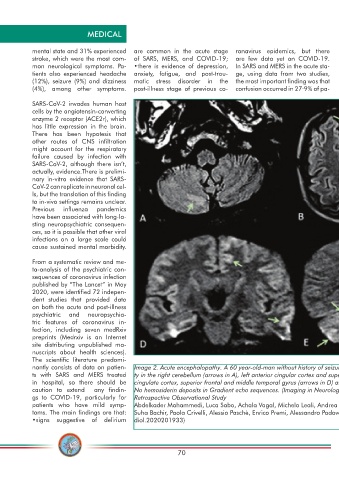
            nantly consists of data on patien-  Image 2. Acute encephalopathy. A 60 year-old-man without history of seizures presenting with convulsion. (A-B) Multifocal areas of FLAIR hyperintensi-
            ts with SARS and MERS treated  ty in the right cerebellum (arrows in A), left anterior cingular cortex and superior frontal gyrus (arrows in B). (C-D) Restricted diffusion in the left anterior
            in hospital, so there should be  cingulate cortex, superior frontal and middle temporal gyrus (arrows in D) and right cerebellum (arrows in E), consistent with cerebellar diaschisis. F)
            caution  to  extend    any  fi ndin-  No hemosiderin deposits in Gradient echo sequences. (Imaging in Neurological Disease of Hospitalized COVID-19 Patients: An Italian Multicenter
            gs to  COVID-19,  particularly for  Retrospective Observational Study
            patients  who  have mild symp-      Abdelkader Mahammedi, Luca Saba, Achala Vagal, Michela Leali, Andrea Rossi, Mary Gaskill, Soma Sengupta, Bin Zhang, Alessandro Carriero,
            toms. The main fi ndings are that:   Suha Bachir, Paola Crivelli, Alessio Paschè, Enrico Premi, Alessandro Padovani, and Roberto Gasparotti  https://pubs.rsna.org/doi/10.1148/ra-
            •signs suggestive  of delirium  diol.2020201933)


                                                               70

