


Page 42 - Coespu 2020-2
P. 42
ALUMNI


            6.Bureaucracy.                      objectives.                         nizations. In this context, the Cen-
            7.Infl uence of leaders, due to the   2.Simplifi cation of organizational   tre of Excellence for Stability Police
            following aspects:                  structures.                         Units (CoESPU), based in Vicenza,
              a.Personality/Ego/Character.      3.Creating an environment of        Italy, is leading the training of civi-
              b.Personal ambitions.             teamwork and teambuilding.          lian, police and military personnel
              c.Experience.                     4.Reduce bureaucracy.               from different countries around the
              d.Knowledge.                      5.Generate the conditions to faci-  world, in a training course called
              e.Intellectual level.             litate the interaction between the   “Civil-Police-Military  Relations”.
              f.Commitment.                     different components.               As part of the CoESPU’s annual
              g.Professionalism.                6.Staff training and development    training plan, the 26th Civil,  Po-
            To eliminate or minimize  the ne-   at all levels.                      lice and  Military  Relations cour-
                                                                                    se (26 C.P.M.)  was held from
                                                                                    11th   February to  5th  March this
                                                                                    year,  with the participation  of
                                                                                    33  students from 21  different
                                                                                    countries  in Europe, Asia, Afri-
                                                                                    ca, South America and Oceania.
                                                                                    The objective of  the course is to
                                                                                    create better and  more effective
                                                                                    collaboration  between the diffe-
                                                                                    rent components of  the  mission,
                                                                                    which will be deployed in non-sta-
                                                                                    bilized areas, in the context of
                                                                                    peace operations.  The course  is
                                                                                    organized in two  main phases:
                                                                                    Phase 1:
                                                                                    This part  of  the course is theore-
                                                                                    tical, where students get  all the
                                                                                    information, knowledge and expe-
                                                                                    riences  related to  the subject, gi-
                                                                                    ving them the tools to understand
                                                                                    the environment and the needs
                                                                                    for strong connections  between
                                                                                    the civil, police and military com-
                                                                                    ponents, to achieve  the strategic
                                                                                    objectives of the organization.
                                                                                    Phase 2:
                                                                                    At the end of the course and during
                                                                                    one week, the students, as part of
                                                                                    the United Nations staff, integrate
                                                                                    a team in which all three compo-
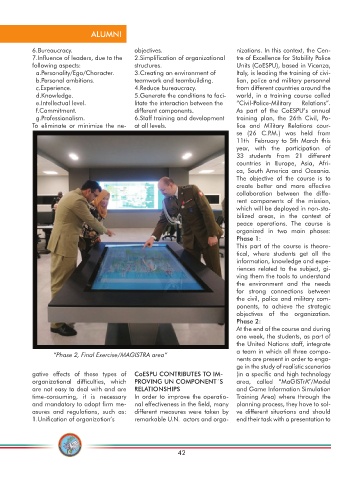
                    “Phase 2, Final Exercise/MAGISTRA area”
                                                                                    nents are present in order to enga-
                                                                                    ge in the study of realistic scenarios
            gative  effects of  these types of  CoESPU CONTRIBUTES TO IM-           (in a specifi c and high technology
            organizational  diffi culties,  which  PROVING UN COMPONENT´S            area, called “MaGISTrA”/Model
            are not easy to deal with and are  RELATIONSHIPS                        and Game Information Simulation
            time-consuming, it is necessary  In order to improve the operatio-      Training Area) where through the
            and mandatory to adopt fi rm me-     nal effectiveness in the fi eld, many  planning process, they have to sol-
            asures  and regulations, such  as:  different measures  were taken by  ve different situations and should
            1.Unifi cation of organization’s     remarkable U.N.  actors and orga-   end their task with a presentation to


                                                               42

