


Page 41 - Coespu 2020-2
P. 41
Throughout the daily work it
    is frequently witnessed how
    different concepts and de-
    fi nitions  regarding  the  pro-
    cesses and means to achieve
    the organization´s objectives
    are commonly mistaken.  A
    typical misinterpretation  is
    when we refer to  the  term
    group and team work. To cla-
    rify the idea, we have to de-
    fi ne  the  following  concepts:
    1.Group:
    “A number of people or
    things that are located clo-
    se together or  are consi-
    dered or classed together”
    2.Team:
    “A number of persons asso-
    ciated together in work or acti-
    vity to reach a common goal”        ness    of   the    organization.   the main objective is common and
    Based  on  the  defi nitions,  we  can   To  understand  the complexi-   well known by the components, the
    conclude that there is no doubt     ty  of  the problem, it  is necessary  intermediate goals (objectives  of
    about the way in which we can re-   to have a clear vision of how the  the components) may be different,
    ach U.N. objectives; therefore te-  U.N. components work to achie-      moving toward the direction of the
    amwork is not an                                    ve  the organiza-   organization’s objective, but in pa-
    option,  it is the                                  tion´s objectives  rallel,  affecting the organization’s
    only way to suc-                                    and  aims. Ini-     objectives, in the following ways:
    ceed  in  the  fi ght                                tially, and once  1.Diffi culties in achieving the
    for  world  peace.                                  the     organiza-   objectives at all levels.
    Taking into ac-                                     tion’s  objective   2.Decrease in the organization’s
    count the cla-                                      is established  in  effectiveness.
    rifi cation   and                                    a  specifi c  mis-   3.Delaying the completion of
    importance     of                                   sion, the compo-    tasks.
    such    concepts,                                   nents, as a basic  4.Duplicating efforts.
    we would  like                                      and fundamental  5.Creating or increasing friction
    to  point  out  that                                support of the  among staff, especially at mana-
    the reality in-                                     main      objecti-  gement levels.
    dicates that  in                                    ve, proceed to  Such limitations (in many cases) are
    many  occasions                                     establish    their  the result of the following factors:
    U.N. components                                     goals  to  support  1.Lack of knowledge of the other
    work hard, as a                                     and     contribu-   components (objectives, organiza-
    group and not as                                    te to the achie-    tion, tasks and procedures).
    a team, particu-                                    vement  of that  2.The characteristics and particu-
    larly among  the                                    main    objective.  larities of the components.
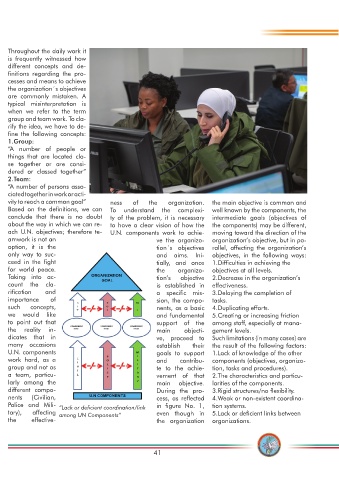
    different compo-                                    During the pro-     3.Rigid structures/no fl exibility.
    nents   (Civilian,                                  cess,  as  refl ected  4.Weak or non-existent coordina-
    Police and  Mili-  “Lack or defi cient coordination/link   in  fi gure  No.  1,  tion systems.
    tary),  affecting  among UN Components”             even though in  5.Lack or defi cient links between
    the     effective-                                  the organization  organizations.


                                                       41

