


Page 22 - Coespu 2020-2
P. 22
HUMAN, TACTICAL OR TECHNICAL: THE
         NATURE OF MODERN PEACEKEEPERS
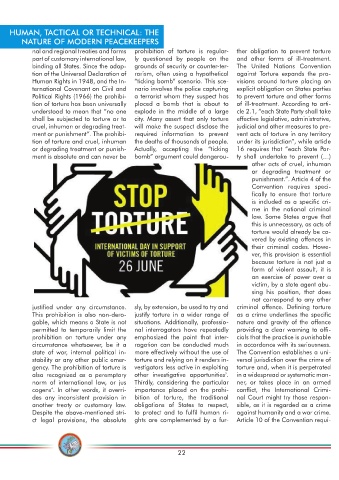
            nal and regional treaties and forms  prohibition of torture  is regular-  ther obligation to  prevent torture
            part of customary international law,  ly questioned by people on the  and other forms  of ill-treatment.
            binding all States. Since the adop-  grounds of security or counter-ter-  The United Nations Convention
            tion of the Universal Declaration of  rorism, often using a hypothetical  against Torture expands the pro-
            Human Rights in 1948, and the In-   “ticking bomb” scenario. This sce-  visions  around torture placing an
            ternational Covenant on Civil and  nario involves the police capturing  explicit obligation on States parties
            Political Rights (1966) the prohibi-  a terrorist whom they suspect has  to prevent torture and other forms
            tion of torture has been universally  placed a bomb that is  about  to  of ill-treatment. According to arti-
            understood to mean that “no one  explode  in the  middle of  a  large  cle 2.1, “each State Party shall take
            shall be subjected to torture or to  city. Many assert that only torture  effective legislative, administrative,
            cruel, inhuman or degrading treat-  will make the suspect disclose the  judicial and other measures to pre-
            ment or punishment”. The prohibi-   required information to  prevent  vent acts of torture in any territory
            tion of torture and cruel, inhuman  the deaths of thousands of people.  under its jurisdiction”, while article
            or degrading treatment or punish-   Actually, accepting the “ticking  16  requires that  “each State  Par-
            ment is absolute and can never be  bomb” argument could dangerou-       ty shall undertake to  prevent (…)
                                                                                         other acts of cruel, inhuman
                                                                                         or degrading treatment or
                                                                                         punishment.”. Article 4 of the
                                                                                         Convention requires speci-
                                                                                         fi cally  to  ensure  that  torture
                                                                                         is included as a specifi c cri-
                                                                                         me in the national criminal
                                                                                         law. Some States argue that
                                                                                         this is unnecessary, as acts of
                                                                                         torture would already be co-
                                                                                         vered by existing offences in
                                                                                         their criminal codes. Howe-
                                                                                         ver, this provision is essential
                                                                                         because torture is not just a
                                                                                         form of violent assault, it is
                                                                                         an exercise of power over a
                                                                                         victim, by a state agent abu-
                                                                                         sing his position,  that  does
                                                                                         not correspond to any other
            justifi ed  under  any  circumstance.  sly, by extension, be used to try and  criminal  offence.  Defi ning  torture
            This prohibition is also non-dero-  justify torture in a wider range of  as a crime underlines the specifi c
            gable, which means a State is not  situations. Additionally,  professio-  nature  and  gravity  of  the  offence
            permitted to temporarily limit  the  nal interrogators have  repeatedly  providing a clear warning to offi -
            prohibition  on torture  under  any  emphasized the point that  inter-  cials that the practice is punishable
            circumstance  whatsoever, be it a  rogation  can be conducted much  in accordance with its seriousness.
            state  of  war,  internal political in-  more effectively without the use of  The Convention establishes a uni-
            stability or any other public emer-  torture and relying on it renders in-  versal jurisdiction over the crime of
            gency. The prohibition of torture is  vestigators less active in exploiting  torture and, when it is perpetrated
            also recognized as a peremptory  other investigative opportunities .    in a widespread or systematic man-
                                                                                5
            norm of international law, or jus  Thirdly, considering  the particular  ner, or takes place in  an armed
            cogens . In other words, it overri-  importance placed on the prohi-    confl ict,  the  International  Crimi-
                   4
            des any inconsistent provision in  bition of torture, the traditional  nal Court might try those respon-
            another treaty or customary law.    obligations of States to respect,  sible, as it is regarded as a crime
            Despite the above-mentioned stri-   to  protect  and  to  fulfi l  human  ri-  against humanity and a war crime.
            ct legal provisions,  the absolute  ghts  are complemented by  a  fur-  Article 10 of the Convention requi-


                                                               22

