


Page 21 - Coespu 2020-2
P. 21
nal institutions attitude  towards it  It  is  fi rst  necessary  to  stress  that  involved; (c) for a specifi c purpose.
    is often  far  from being  consistent  part of the misunderstanding  Any act that falls short of the de-
    with the spirit of its prohibition  about torture is caused by the dif-  fi nition of torture because it lacks
    and demonstrates to be based  ference  between  the  legal  defi ni-     one or more of the criteria may
    on  misconception  and  prejudice.  tion of torture and the way the term  still be covered  under article 16
    In  fact,  although  recipient States  is commonly used in the media or  of the Convention against Torture
    have a clear and undebated duty  in general conversation, which  that outlines the prohibition of  “…
    to  prevent torture,  and  declare  often emphasizes  the intensity  of  other acts of cruel, inhuman or de-
    themselves fully committed in it, it  pain  and  suffering  infl icted.  Arti-  grading  treatment or  punishment
    is often not applied in practice. The  cle 1 of the United Nations Con-  which do  not  amount  to  torture
    political, social and cultural envi-  vention against Torture and Other  as defi ned in article 1, when such
    ronment frequently characterized  Cruel, Inhuman or Degrading Tre-      acts are committed by or at the in-
    by lack  of respect  for the rule of  atment or Punishment (1984)  pro-  stigation of or with the consent or
                                                                    1
    law, high levels of corruption and  vides the  internationally agreed  acquiescence  of  a  public  offi cial
    a culture of violence increases the  legal  defi nition  of  torture:  “Tortu-  or other person acting in an offi -
    diffi culties in implementing effecti-  re means any act by which severe  cial capacity.”  It is relevant to em-
    ve  reforms  against torture. Chal-  pain or suffering, whether physical  phasize that any pain or suffering
    lenging torture therefore requires  or mental, is intentionally infl icted  arising  “only from, inherent in  or
    a comprehensive strategy with the  on a person for such purposes as  incidental to” lawful sanctions is
    active involvement of many actors.  obtaining from him or a third per-  explicitly not considered as torture.
    To some extent, it is correct to point  son information  or  a  confession,  Nevertheless, this clause cannot be
    out that, at an international level,  punishing him for an act he or a  used to justify the use of corporal
    the practical application  of  the  third person has committed  or is  punishments  under domestic law.
    prohibition of torture represents  suspected of having committed, or  Despite the issue of “legalized”
    one  sensitive  topic  in  the  fi eld  of  intimidating or coercing him or a  corporal punishments  has been
    human rights. Even  the most im-    third person, or for any reason ba-  raised by  some States under the
    portant  police and  troops  contri-  sed on discrimination of any kind,  so-called  “lawful sanctions”  clau-
    buting  countries, despite the im-  when such pain or suffering is in-  se,  it  has  been  fi rmly  established
    plementation of  many legal and  fl icted by or at the instigation of or  that they are prohibited under in-
    practical preventive tools,  are  with the consent or acquiescence  ternational law. The lawfulness of
    still facing the problem of rende-  of  a  public  offi cial  or  other  per-  the sanction should be determined
    ring it effective. What  emerges is  son  acting  in  an  offi cial  capacity.  by international standards,  inclu-
    that,  despite the clear internatio-  It does not include pain or suffe-  ding the United Nations Standard
    nal legal framework, outside the  ring arising only from, inherent in  Minimum Rules for the Treatment
    circle  of spe-                                                                         of     Prisoners ,
                                                                                                            2
    cialized practi-                                                                        which  was spe-
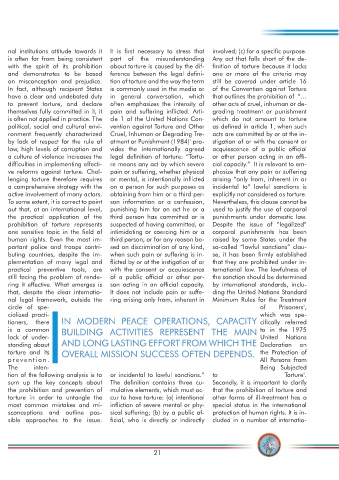
    tioners, there     IN  MODERN PEACE OPERATIONS, CAPACITY                                cifi cally  referred
    is  a common       BUILDING ACTIVITIES  REPRESENT THE MAIN                              to  in the 1975
    lack  of under-                                                                         United Nations
    standing about     AND LONG LASTING EFFORT FROM WHICH THE                               Declaration  on
    torture  and its   OVERALL MISSION SUCCESS OFTEN DEPENDS.                               the Protection of
    prevention.                                                                             All Persons  from
    The      inten-                                                                         Being Subjected
    tion of the following analysis is to  or incidental to lawful sanctions.”  to                    Torture .
                                                                                                            3
    sum up  the key concepts about  The  defi nition  contains  three  cu-   Secondly, it is important to clarify
    the prohibition and  prevention of  mulative elements, which must oc-   that the prohibition of torture and
    torture  in order to  untangle the  cur to have torture: (a) intentional  other forms of ill-treatment has a
    most common mistakes and  mi-       infl iction of severe mental or phy-  special  status in the international
    sconceptions  and outline pos-      sical suffering; (b) by a public of-  protection of human rights. It is in-
    sible approaches  to  the issue.    fi cial,  who  is  directly  or  indirectly  cluded in a number of internatio-


                                                       21

