


Page 33 - Coespu 2018-4
P. 33
applying the principle of proportionality.  In this context, the Court specifies that often the conflicts
            are  only  apparent,  as  in  the  case  concerned,  given  that  the  rights  of  Nature  concur  with  the
            fundamental rights of man, such as the right to health, to a dignified life and to live in a healthy
            environment.
            In Bolivia, the judiciary remedy envisaged is the “acción popular” (public interest suit) which can
            be  filed  against  the  acts  or  omissions  of  authorities,  individuals  or  collectives  that  violate,  or
            threaten to violate, rights and collective interests, including the environment (art. 135 Cost.). The
            Bolivian  law  has  three  aims:    (1)  preventive,  by  averting  a  threat  to  the  rights  and  collective
            interests,  (2)  suspensive,  through  cessation  of  the  effects  produced  by  the  damaging  act  and  (3)
            reparative,  with  the  obligation  to  restore  the
            conditions  prior  to  the  damage  (Baldin,
            2014b).
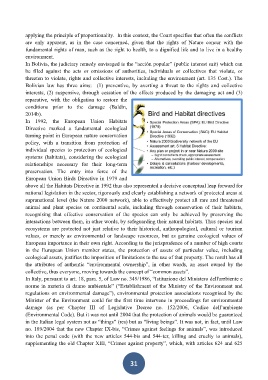
            In  1992,  the  European  Union  Habitats
            Directive  marked  a  fundamental  ecological
            turning point in European nature conservation
            policy,  with  a  transition  from  protection  of
            individual  species  to  protection  of  ecological
            systems  (habitats),  considering  the  ecological
            relationships  necessary  for  their  long-term
            preservation.  The  entry  into  force  of  the
            European Union Birds Directive in 1979 and
            above all the Habitats Directive in 1992 thus also represented a decisive conceptual leap forward for
            national legislation in the sector, rigorously and clearly establishing a network of protected areas at
            supranational level (the Nature 2000 network), able to effectively protect all rare and threatened
            animal  and  plant  species  on  continental  scale,  including  through  conservation  of  their  habitats,
            recognising  that  effective  conservation  of  the  species  can  only  be  achieved  by  preserving  the
            interactions between them, in other words, by safeguarding their natural habitats. Thus species and
            ecosystems  are  protected  not  just  relative  to  their  historical,  anthropological,  cultural  or  tourism
            values,  or  merely  as  environmental  or  landscape  resources,  but  as  genuine  ecological  values  of
            European importance in their own right. According to the jurisprudence of a number of high courts
            in  the  European  Union  member  states,  the  protection  of  assets  of  particular  value,  including
            ecological assets, justifies the imposition of limitations to the use of that property. The result has all
            the  attributes  of  authentic  “environmental  ownership”,  in  other  words,  an  asset  owned  by  the
            collective, thus everyone, moving towards the concept of “common assets”.
            In Italy, pursuant to art. 18, para. 5, of Law no. 349/1986, “Istituzione del Ministero dell'ambiente e
            norme in materia di danno ambientale” (“Establishment of the Ministry of the Environment and
            regulations on  environmental damage”), environmental  protection  associations recognised by the
            Minister  of the  Environment  could  for  the  first time intervene in proceedings  for  environmental
            damage  (as  per  Chapter  III  of  Legislative  Decree  no.  152/2006,  Codice  dell’ambiente
            (Environmental Code). But it was not until 2004 that the protection of animals would be guaranteed
            in the Italian legal system not as “things” (res) but as “living beings”. It was not, in fact, until Law
            no. 189/2004 that the new Chapter IX-bis, “Crimes against feelings for animals”, was introduced
            into  the  penal  code  (with  the  new  articles  544-bis  and  544-ter,  killing  and  cruelty  to  animals),
            supplementing the old Chapter XIII, “Crimes against property”, which, with articles 624 and 625


                                                           31

