


Page 31 - Coespu 2018-4
P. 31
In April 2010, the “Universal Declaration of
            the Rights of Mother Earth”  was
            proclaimed during the “Conferencia Mundial
            de los Pueblos sobre el Cambio Climático y
            los  Derechos de  la Madre Tierra”  held at
            Cochabamba  (Bolivia).  The  first  article  of
            the  Declaration  proclaims  Mother  Earth
            as  a  living  being,  a  community  of
            interrelated and interdependent creatures, all
            entitled  to  the  inherent  rights  recognized  in
            the  Declaration,  without  distinction  of  any
            kind between beings, species, origin or other status. Drawn up with a contribution from Cullinan
            (2011), this document is today being considered by the UN with a view to its adoption.
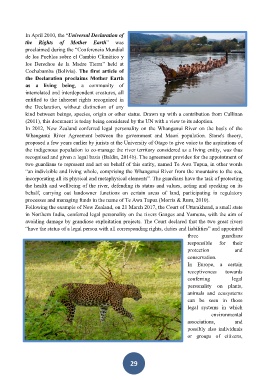
            In  2012,  New  Zealand  conferred  legal  personality  on  the  Whanganui  River  on  the  basis  of  the
            Whanganui  River  Agreement  between  the  government  and  Maori  population.  Stone's  theory,
            proposed a few years earlier by jurists at the University of Otago to give voice to the aspirations of
            the indigenous population to co-manage the river territory considered as a living entity, was thus
            recognised and given a legal basis (Baldin, 2014b). The agreement provides for the appointment of
            two guardians to represent and act on behalf of this entity, named Te Awa Tupua, in other words
            “an indivisible and living whole, comprising the Whanganui River from the mountains to the sea,
            incorporating all its physical and metaphysical elements”. The guardians have the task of protecting
            the health and wellbeing of the river, defending its status and values, acting and speaking on its
            behalf,  carrying  out  landowner  functions  on  certain  areas  of  land,  participating  in  regulatory
            processes and managing funds in the name of Te Awa Tupua (Morris & Ruru, 2010).
            Following the example of New Zealand, on 21 March 2017, the Court of Uttarakhand, a small state
            in Northern India, conferred legal personality on the rivers Ganges and Yamuna, with the aim of
            avoiding damage by grandiose exploitation projects. The Court declared that the two great rivers
            “have the status of a legal person with all corresponding rights, duties and liabilities” and appointed
                                                                                    three          guardians
                                                                                    responsible   for   their
                                                                                    protection           and
                                                                                    conservation.
                                                                                    In  Europe,  a  certain
                                                                                    receptiveness    towards
                                                                                    conferring          legal
                                                                                    personality  on  plants,
                                                                                    animals  and  ecosystems
                                                                                    can  be  seen  in  those
                                                                                    legal  systems  in  which
                                                                                               environmental
                                                                                    associations,        and
                                                                                    possibly also individuals
                                                                                    or  groups  of  citizens,


                                                           29

