


Page 28 - Coespu 2018-4
P. 28
achievements  of  this  COP24  are  likely  to  be  highly  insufficient to  meet the urgency of  the
               challenge.
               And yet it is so crucial to reduce GHG emissions (climate change mitigation) and to finance
               adaptation to the effect of climate change in most vulnerable countries (typically development
               countries).  Climate  change  is  having  economic  and  socio-political  effects. Food  security is
               already  being  impacted  in  a  number  of  African  countries  and  elsewhere,  and  researchers  are
               studying suggestive links between climate change and an increased likelihood of military conflict
               and  internal  (within  States)  and international  migration.  Indeed,  we're  already  seeing  the  first
               climate refugees as people are displaced by rising sea levels, melting Arctic permafrost and other
               extreme weather. Climate change does not only affect humans. Warming ocean temperatures are
               increasing  the  frequency  of coral  reef  bleaching;  warmer,  drier  weather  means  that  forests  in
               some regions are no longer recovering from wildfires and wildlife habitats around the world are
               becoming less hospitable to animals.
               We are responsible for climate change. While a wide range of natural phenomena can radically
                                                                                    7
               affect the climate, publishing climate scientists overwhelmingly agree  that global warming and
               resultant climate effects that we're witnessing are the result of human activity. It is therefore for
               us to take action, in the narrow window of time still available before we enter an unchartered
               territory, marked by a completely unpredictable climate with consequences difficult to imagine.


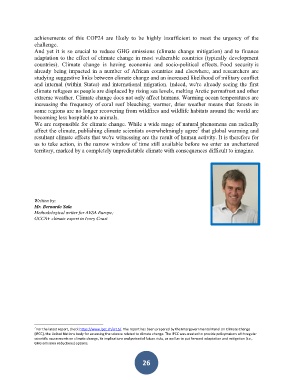
               Written by:
               Mr. Bernardo Sala
               Methodological writer for AESA Europe;
               GCCA+ climate expert in Ivory Coast


               7
                 For the latest report, check https://www.ipcc.ch/sr15/. The report has been prepared by the Intergovernmental Panel on Climate Change
               (IPCC), the United Nations body for assessing the science related to climate change. The IPCC was created to provide policymakers with regular
               scientific assessments on climate change, its implications and potential future risks, as well as to put forward adaptation and mitigation (i.e.,
               GHG emission reductions) options.


                                                             26

