


Page 23 - Coespu 2018-4
P. 23
environmental  baseline  study  (which  ensures  that  pre-existing  environmental  conditions  are
            documented  prior  to  the  start  of  mission  operations  and  following  mission  closure)  and  the
            environmental  action  plan,  liaise  on  environmental  issues  with  local  authorities  and  investigate
            complaints  or  report  of  pollution,  contamination,  health  hazards  and  other  environment-related
            incidents, submit a report on environmental issues to the Director of Mission Support and provide
            environmental briefing to police and military contingents during their induction training.
            Each UN field mission will take actions to integrate environmental measures into its planning
            and  operations  in  order  to  avoid  and  minimize  the  impact  of  activities  carried  out  by  the
            mission  and  its  staff  on  the  environment  and  to  protect  human  health  from  such
            environmental impact.
            In the same way it is important monitoring of environmental performance of the mission because
            low environmental impact is an everyday issue, from the planning of the mission to its closure.
            Everyone, involved in the peace mission, has to be aware that taking care of environment is a part
            of his or her work. Protection of environment is important by itself, but also in order to protect the
            reputation of UN as well as to maintain
            good     relationships   with     local
            population:  a  bad  environmental
            management may raise issues during
            and after the mission and create other
            problems  which  could  compromise
            mission’s success.
            This  is  the  very  challenging  premise
            that    create     the    fundamental
            consideration  of  the  “Environmental
            Chair”.
            The  first  year  of  its  activity  has  been
            rich  and  very  interesting:  the  fellow
            had  the  opportunity  to  be  part  of  a
            project in  Rwanda,  for  training  police
            and rangers on environmental subjects.
            This mission is based on the Memorandum of Understanding which has been sub signed between
            the Rwandan National Police and the Arma dei Carabinieri.
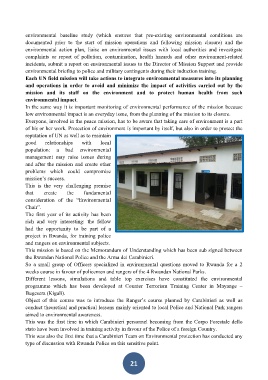
            So  a  small  group  of  Officers  specialized  in  environmental  questions  moved  to  Rwanda  for  a  2
            weeks course in favour of policemen and rangers of the 4 Rwandan National Parks.
            Different  lessons,  simulations  and  table  top  exercises  have  constituted  the  environmental
            programme  which  has  been  developed  at  Counter  Terrorism  Training  Center  in  Mayange  –
            Bugesera (Kigali).
            Object  of  this  course  was  to  introduce  the  Ranger’s  course  planned  by  Carabinieri  as  well  as
            conduct theoretical and practical lessons mainly oriented to local Police and National Park rangers
            aimed to environmental awareness.
            This was the first time in which Carabinieri personnel becoming from the Corpo Forestale dello
            stato have been involved in training activity in favour of the Police of a foreign Country.
            This was also the first time that a Carabinieri Team on Environmental protection has conducted any
            type of discussion with Rwanda Police on this sensitive point.


                                                           21

