


Page 35 - Coespu 2018-4
P. 35
“Gar-Si Sahel Project”:

                            the relevance of environmental matters


            By Maj. Michele VIALE

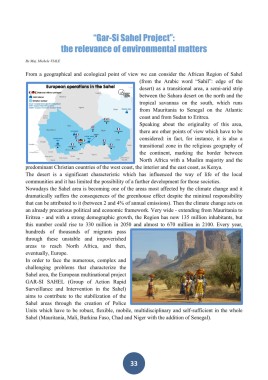
            From a geographical and ecological point of view we can consider the African Region of Sahel
                                                               (from  the  Arabic  word  “Sahil”:  edge  of  the
                                                               desert) as a transitional area, a semi-arid strip
                                                               between the Sahara desert on the north and the
                                                               tropical  savannas  on  the  south,  which  runs
                                                               from  Mauritania  to  Senegal  on  the  Atlantic
                                                               coast and from Sudan to Eritrea.
                                                               Speaking  about  the  originality  of  this  area,
                                                               there are other points of view which have to be
                                                               considered:  in  fact,  for  instance,  it  is  also  a
                                                               transitional zone in the religious geography of
                                                               the  continent,  marking  the  border  between
                                                               North  Africa  with  a  Muslim  majority  and the
            predominant Christian countries of the west coast, the interior and the east coast, as Kenya.
            The  desert  is  a  significant  characteristic  which  has  influenced the way of  life  of the local
            communities and it has limited the possibility of a further development for those societies.
            Nowadays the Sahel area is becoming one of the areas most affected by the climate change and it
            dramatically suffers the consequences of the greenhouse effect despite the minimal responsibility
            that can be attributed to it (between 2 and 4% of annual emissions). Then the climate change acts on
            an already precarious political and economic framework. Very wide - extending from Mauritania to
            Eritrea - and with a strong demographic growth, the Region has now 135 million inhabitants, but
            this  number  could  rise  to  330  million  in  2050  and  almost  to  670  million  in  2100.  Every  year,
            hundreds  of  thousands  of  migrants  pass
            through  these  unstable  and  impoverished
            areas  to  reach  North  Africa,  and  then,
            eventually, Europe.
            In  order  to  face  the  numerous,  complex  and
            challenging  problems  that  characterize  the
            Sahel area, the European multinational project
            GAR-SI  SAHEL  (Group  of  Action  Rapid
            Surveillance  and  Intervention  in  the  Sahel)
            aims  to  contribute  to  the  stabilization  of  the
            Sahel  areas  through  the  creation  of  Police
            Units which have to be robust, flexible, mobile, multidisciplinary and self-sufficient in the whole
            Sahel (Mauritania, Mali, Burkina Faso, Chad and Niger with the addition of Senegal).


                                                           33

