


Page 229 - La Grande Guerra dei Carabinieri
P. 229
229
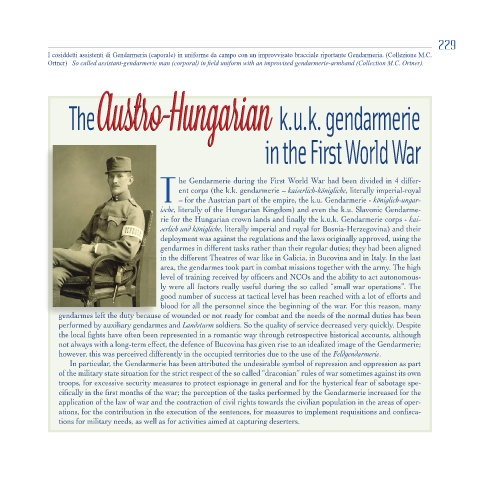
             I cosiddetti assistenti di Gendarmeria (caporale) in uniforme da campo con un improvvisato bracciale riportante Gendarmeria. (Collezione M.C.
             Ortner)   So called assistant-gendarmerie man (corporal) in field uniform with an improvised gendarmerie-armband (Collection M.C. Ortner).


                   The Austro-Hungarian
                          Austro-Hungarian k.u.k. gendarmerie


                                                                      in the First World War


                                               he Gendarmerie during the First World War had been divided in 4 differ-
                                               ent corps (the k.k. gendarmerie – kaiserlich-königliche, literally imperial-royal
                                           T – for the Austrian part of the empire, the k.u. Gendarmerie - königlich-ungar-
                                           ische, literally of the Hungarian Kingdom) and even the k.u. Slavonic Gendarme-
                                           rie for the Hungarian crown lands and finally the k.u.k. Gendarmerie corps - kai-
                                           serlich und königliche, literally imperial and royal for Bosnia-Herzegovina) and their
                                           deployment was against the regulations and the laws originally approved, using the
                                           gendarmes in different tasks rather than their regular duties; they had been aligned
                                           in the different Theatres of war like in Galicia, in Bucovina and in Italy. In the last
                                           area, the gendarmes took part in combat missions together with the army. The high
                                           level of training received by officers and NCOs and the ability to act autonomous-
                                           ly were all factors really useful during the so called “small war operations”. The
                                           good number of success at tactical level has been reached with a lot of efforts and
                                           blood for all the personnel since the beginning of the war. For this reason, many
                gendarmes left the duty because of wounded or not ready for combat and the needs of the normal duties has been
                performed by auxiliary gendarmes and Landsturm soldiers. So the quality of service decreased very quickly. Despite
                the local fights have often been represented in a romantic way through retrospective historical accounts, although
                not always with a long-term effect, the defence of Bucovina has given rise to an idealized image of the Gendarmerie;
                however, this was perceived differently in the occupied territories due to the use of the Feldgendarmerie.
                   In particular, the Gendarmerie has been attributed the undesirable symbol of repression and oppression as part
                of the military state situation for the strict respect of the so called “draconian” rules of war sometimes against its own
                troops, for excessive security measures to protect espionage in general and for the hysterical fear of sabotage spe-
                cifically in the first months of the war; the perception of the tasks performed by the Gendarmerie increased for the
                application of the law of war and the contraction of civil rights towards the civilian population in the areas of oper-
                ations, for the contribution in the execution of the sentences, for measures to implement requisitions and confisca-
                tions for military needs, as well as for activities aimed at capturing deserters.

