


Page 43 - Coespu 2018-4
P. 43
Environment Protection and Malnutrition:

                                            a close relationship

            By Dr. Davide PEREGO

                                                                    When we treat the matter of Environment
                                                                    Protection, we think about of the habitat,
                                                                    to  the  protection  of  nature  and  the
                                                                    ecosystem.  It's  right,  but  we  have  to
                                                                    consider also life condition of the civilian
                                                                    population. In this situation specific types
                                                                    of disease can be a challenge for us, and
                                                                    always health risks differ from country to
                                                                    country. What is instead a common factor
                                                                    in  all  region  where  we  are  involved  in
                                                                    peace  mission,  is  very  often  the
                                                                    malnutrition.
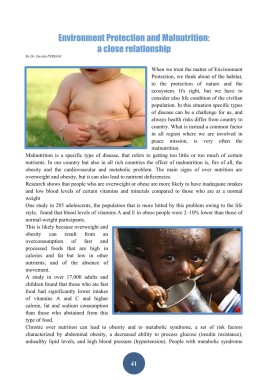
            Malnutrition  is  a  specific  type  of  disease,  that  refers  to  getting  too little  or  too  much  of  certain
            nutrients. In our country but also in all rich countries the effect of malnutrition is, firs of all, the
            obesity  and  the  cardiovascular  and  metabolic  problem.  The  main  signs  of  over  nutrition  are
            overweight and obesity, but it can also lead to nutrient deficiencies.
            Research shows that people who are overweight or obese are more likely to have inadequate intakes
            and  low  blood  levels  of  certain  vitamins  and  minerals  compared  to those who  are  at a normal
            weight
            One study in 285 adolescents, the population that is more hitted by this problem owing to the life
            style,  found that blood levels of vitamins A and E in obese people were 2–10% lower than those of
            normal-weight participants.
            This is likely because overweight and
            obesity    can    result   from    an
            overconsumption      of   fast    and
            processed  foods  that  are  high  in
            calories  and  fat  but  low  in  other
            nutrients,  and  of  the  absence  of
            movement.
            A  study  in  over  17,000  adults  and
            children found that those who ate fast
            food  had  significantly  lower  intakes
            of  vitamins  A  and  C  and  higher
            calorie,  fat  and  sodium  consumption
            than  those  who  abstained  from  this
            type of food.
            Chronic  over  nutrition  can  lead  to  obesity  and  to  metabolic  syndrome, a set of  risk factors
            characterized  by  abdominal  obesity,  a  decreased  ability  to  process  glucose  (insulin  resistance),
            unhealthy  lipid  levels,  and  high  blood  pressure  (hypertension).  People  with  metabolic  syndrome


                                                           41

