


Page 44 - Coespu 2018-4
P. 44
have been shown to be at a greater risk of developing type 2 diabetes and cardiovascular disease.
Another uncommon form of over nutrition is vitamin or mineral toxicity. This is usually due to
excessive supplementation, for instance, with high
doses of fat-soluble vitamins such as vitamin A
rather than the ingestion of food. Toxicity symptoms
depend on the substance(s) ingested, the severity of
the overdose, and whether it is acute or chronic.
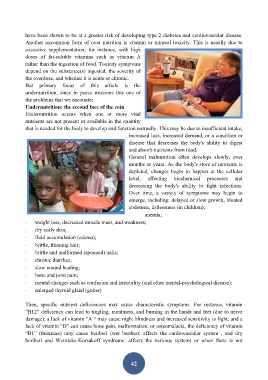
But primary focus of this article is the
undernutrition, since in peace missions this one of
the problems that we encounter.
Undernutrition: the second face of the coin
Undernutrition occurs when one or more vital
nutrients are not present or available in the quantity
that is needed for the body to develop and function normally. This may be due to insufficient intake,
increased loss, increased demand, or a condition or
disease that decreases the body's ability to digest
and absorb nutrients from food.
General malnutrition often develops slowly, over
months or years. As the body's store of nutrients is
depleted, changes begin to happen at the cellular
level, affecting biochemical processes and
decreasing the body's ability to fight infections.
Over time, a variety of symptoms may begin to
emerge, including: delayed or slow growth, bloated
abdomen, listlessness (in children);
anemia;
weight loss, decreased muscle mass, and weakness;
dry scaly skin;
fluid accumulation (edema);
brittle, thinning hair;
brittle and malformed (spooned) nails;
chronic diarrhea;
slow wound healing;
bone and joint pain;
mental changes such as confusion and irritability (and other mental-psychological disease);
enlarged thyroid gland (goiter)
Then, specific nutrient deficiencies may cause characteristic symptoms. For instance, vitamin
“B12” deficiency can lead to tingling, numbness, and burning in the hands and feet (due to nerve
damage); a lack of vitamin “A “ may cause night blindness and increased sensitivity to light; and a
lack of vitamin “D” can cause bone pain, malformation, or osteomalacia, the deficiency of vitamin
“B1” (thiamine) may cause beriberi (wet beriberi: affects the cardiovascular system , and dry
beriberi and Wernicke-Korsakoff syndrome: affects the nervous system) or when there is not
42

