


Page 46 - Coespu 2018-4
P. 46
third of all childhood deaths are linked to malnutrition. Food shortages and intestinal parasites are
            leading causes of malnutrition in the developing world;
                                                                         Acute  conditions  such  as  surgery,
                                                                         severe burns, infections, and trauma
                                                                         can  drastically  increase  short-term
                                                                         nutritional  requirements.  People
                                                                         who  have  been  malnourished  for
                                                                         some  time  may  have  weakened
                                                                         immune  systems  and  a  poorer
                                                                         prognosis.  They  frequently  take
                                                                         longer  to  heal  from  surgical
                                                                         procedures  and  must  spend  more
                                                                         days in the hospital. For this reason,
                                                                         many  doctors  screen  and  then
                                                                         monitor  the  nutritional  status  of
                                                                         their  hospitalized  patients.  Patients
            having surgery are frequently evaluated both prior to surgery and during their recovery process;
            chronic  diseases  may  be  associated  with  nutrient  loss,  increased  nutrient  demand,  and/or
            malabsorption. Malabsorption may occur
            with  chronic  diseases  such  as  celiac
            disease,   cystic   fibrosis,   pancreatic
            insufficiency, and pernicious anemia. An
            increased  loss  of  nutrients  may  be  seen
            with chronic kidney disease, diarrhea and
            excessive bleeding. Sometimes, both the
            conditions and their treatment can cause
            malnutrition  through  decreased  intake.
            An example of  this are the decreased
            appetite,  difficulty  swallowing,  and
            nausea  associated  both  with  cancer  (and
            chemotherapy).  People  who  chronically
            abuse drugs and/or alcohol might not get enough nutrients, lose too many nutrients and/or cannot
            absorb a sufficient amount of nutrients;
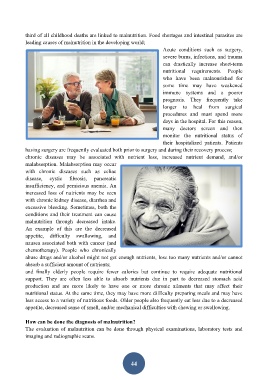
            and  finally  elderly  people  require  fewer  calories  but  continue  to  require  adequate  nutritional
            support.  They  are  often  less  able  to  absorb  nutrients  due  in  part  to  decreased  stomach  acid
            production  and  are  more  likely  to  have  one  or  more  chronic  ailments  that  may  affect  their
            nutritional status. At the same time, they may have more difficulty preparing meals and may have
            less access to a variety of nutritious foods. Older people also frequently eat less due to a decreased
            appetite, decreased sense of smell, and/or mechanical difficulties with chewing or swallowing.

            How can be done the diagnosis of malnutrition?
            The  evaluation  of  malnutrition  can  be  done  through  physical  examinations,  laboratory  tests  and
            imaging and radiographic scans.


                                                           44

