


Page 24 - The CoESPU Magazine N 1 - 2018
P. 24
the door for more women to participate in peacekeeping missions, and to this end she formulated
               her training proposal.
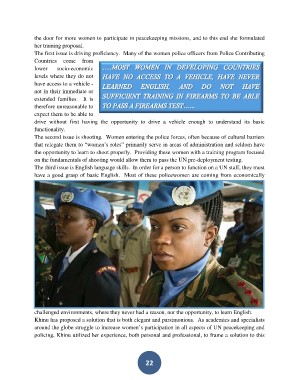
               The first issue is driving proficiency.  Many of the women police officers from Police Contributing
               Countries  come  from
               lower     socio-economic
               levels where they do not
               have access to a vehicle -
               not in their immediate or
               extended  families.    It  is
               therefore unreasonable to
               expect them to be able to
               drive  without  first  having  the  opportunity  to  drive  a  vehicle  enough  to  understand  its  basic
               functionality.
               The second issue is shooting.  Women entering the police forces, often because of cultural barriers
               that relegate them to “women’s roles” primarily serve in areas of administration and seldom have
               the opportunity to learn to shoot properly.  Providing these women with a training program focused
               on the fundamentals of shooting would allow them to pass the UN pre-deployment testing.
               The third issue is English language skills.  In order for a person to function on a UN staff, they must
               have a good grasp of basic English.  Most of these policewomen are coming from economically


               challenged environments, where they never had a reason, nor the opportunity, to learn English.
               Khinu has proposed a solution that is both elegant and parsimonious.  As academics and specialists
               around the globe struggle to increase women’s participation in all aspects of UN peacekeeping and
               policing, Khinu utilized her experience, both personal and professional, to frame a solution to this


                                                              22

