


Page 23 - The CoESPU Magazine N 1 - 2018
P. 23
in three different UN Peacekeeping missions: 2002-2003 UNMIK (Kosovo), 2008-2009 UNMIT
               (Timor-Leste) and 2013-2014 UNAMID (Darfur).
               On International Women’s Day in March of 2009, Khinu was part of the United Nations Mission In
               Timor.  Present that day were representatives of the UN’s Gender Unit from the UN Headquarters
               in New York.  They posed a question, asking what it would take to increase the number of females
               participating  in  UN  missions.    The  UN’s  Gender  Unit  put  this  question  to  the  group  that  day
               consisting of the UN HQ staff, the Police Commissioner of UNMIT, all of the UN civilian female
               staffers,  UN  CIVPOL  members,  as  well  as  local  female  police  officers.    In  the  midst  of  this
               discussion, Khinu made the recommendation that if capacity building training were to be provided
               to female police officers of developing countries, it would have an immediate impact on the number
               of female police officers available to serve in UN Missions.  The Gender Officer then spoke with
               Khinu and asked her if she
               could    put   together   a
               proposal  for  UNMIT  to
               which  she  replied  in  the
               affirmative.  At that point,
               Khinu only had two weeks
               left  in  mission.    So  while
               she  did  develop  a  training
               proposal,  the  plan  seemed
               to  fade  as  she  was  no
               longer  there  to  see  that  it
               moved forward.
               So for nine years, the plan
               envisioned     by    Khinu
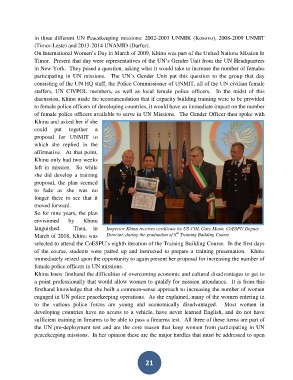
               languished.    Then,  in       Inspector Khinu receives certificate by US COL Gary Mann, CoESPU Deputy
                                                                           th
               March of 2018, Khinu was       Director, during the graduation of 8  Training Building Course
               selected to attend the CoESPU’s eighth iteration of the Training Building Course.  In the first days
               of  the  course,  students  were  paired  up  and  instructed  to  prepare  a  training  presentation.    Khinu
               immediately seized upon the opportunity to again present her proposal for increasing the number of
               female police officers in UN missions.
               Khinu knew firsthand the difficulties of overcoming economic and cultural disadvantages to get to
               a point professionally that would allow women to qualify for mission attendance.  It is from this
               firsthand knowledge that she built a common-sense approach to increasing the number of women
               engaged in UN police peacekeeping operations.  As she explained, many of the women entering in
               to  the  various  police  forces  are  young  and  economically  disadvantaged.    Most  women  in
               developing  countries  have  no  access  to  a  vehicle,  have  never  learned  English,  and  do  not  have
               sufficient training in firearms to be able to pass a firearms test.  All three of these items are part of
               the UN pre-deployment  test and  are the  core reason that keep women from participating in  UN
               peacekeeping missions.  In her opinion these are the major hurdles that must be addressed to open


                                                              21

