


Page 41 - Coespu 2020-1
P. 41
Sudan, Sudan and Somalia), in-      nal consultative sessions involving  vernment  and non-governmen-
    cluding through the capacitation  law enforcement agencies in tar-      tal institutions and across border;
    of regional cooperation and stren-  geted countries, fostering the iden-  •Lack  or  no  coordination  among
    gthening the evidence-based poli-   tification of areas of improvement  key services, including with re-
    cies and operational management.    and capacity-building needs and  gards to mutual legal agreement
                                        highlighting the capacity gaps and  between countries in the region;
    Ensure the local and  regional  challenges  faced by governments  •Misconception  or  confusion  re-
    ownership in addressing institu-    in the region in responding to these  garding  the  status  or  category  of
    tional gaps and challenges          phenomena, informing the identi-    certain  group  of  people  (asylum
    The initial step in  the process  of  fication  of  capacity-building  ne-  seekers,  refugees, internally  di-
    strengthening country and regional  eds in the areas of data collection,  splaced person, migrants) and
    cooperation among the law enfor-    analysis and information sharing.  the need  to  educate  and  familia-
    cement  system was based in  en-    Particular challenges remained in:  rise law enforcement officials and
    suring an appropriate assessment  •Qualifying  the  situations  whe-    the judiciary on the details of the
    and  technical appraisal  of  gaps  re blurring lines existed between  Counter-Trafficking  in  Persons;
    and challenges affecting the public  smuggling of migrants, trafficking  •Restrictive  immigration  policies;
    response to smuggling of migrants  in  human beings  and the need  criminalisation  of  undocumented
    and  trafficking  in  Human  beings.  to reform legislation and policies  or irregular migrants, social  stig-
    In country’s analyses were produ-   to  prevent  criminalising  irregular  ma against certain groups of po-
    ced as part of the AMMI project  migrants  or  victims  of  trafficking;  pulation or type of practises (being
    and  provided  an  updated  over-   •The  gaps  in  the  implementation  engaged in  prostitution activi-
    view of  migrant  smuggling and  of existing frameworks, limited sta-   ties,  undocumented  migrants…).
    human  trafficking  trends  and  keholder capacity, and a lack of  The AMMI’s project, in particular,
    dynamics with an emphasis  to  formal mechanisms for collecting,  supported the establishment of a
    the modus  operandi of  criminal  analysing, and sharing informa-       peer-to-peer network of Senior Of-
    networks involved in facilitating  tion on migrant smuggling and  ficers from police and the judiciary
    irregular  migration.  The  reports  human  trafficking  within  gover-  sector from partner’s countries of
    were strengthened through  natio-   nment  institutions, between  go-   the Khartoum Process, including
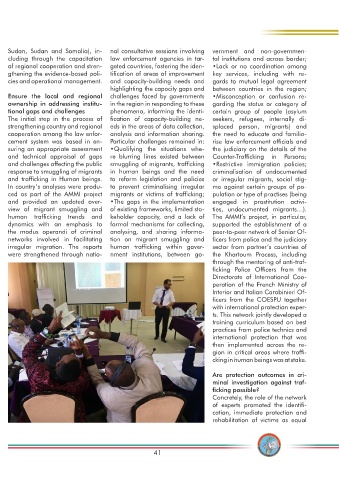
                                                                            through the mentoring of anti-traf-
                                                                            ficking  Police  Officers  from  the
                                                                            Directorate of International Coo-
                                                                            peration of the French Ministry of
                                                                            Interior and Italian Carabinieri Of-
                                                                            ficers  from  the  COESPU  together
                                                                            with international protection exper-
                                                                            ts. This network jointly developed a
                                                                            training curriculum based on best
                                                                            practices from police technics and
                                                                            international protection that  was
                                                                            then implemented  across the  re-
                                                                            gion in critical areas where traffi-
                                                                            cking in human beings was at stake.

                                                                            Are protection outcomes in cri-
                                                                            minal investigation against traf-
                                                                            ficking possible?
                                                                            Concretely, the role of the network
                                                                            of  experts  promoted  the  identifi-
                                                                            cation, immediate protection and
                                                                            rehabilitation of victims  as equal


                                                       41

