


Page 8 - Coespu 2018-4
P. 8
We now have a systematic approach to environmental management. Significant progress has
               been made from our earlier implementation of pilot projects based on anecdotal evidence, such
               as synchronization of generators for improved efficiency, and installation of wastewater
               treatment plants. Peacekeeping missions have established environmental action plans, with
               practical and innovative solutions implemented to address the key areas of waste disposal, water
               and wastewater, and energy.
               In  the  Democratic  Republic  of  the  Congo,  the  peacekeeping  mission  MONUSCO  has
               significantly reduced waste to landfill through composting, recycling and incineration. With a
               general lack of effective municipal options, and limited access to local landfills across missions,
               MINUSMA,  the  peacekeeping
               mission    in   Mali,   achieves
               controlled    waste     disposal
               through incineration. In Bangui,
               Central  African  Republic,  the
               peacekeeping             mission
               MINUSCA  is  working with  the
               municipality  to  rehabilitate  the
               only  landfill  for  the  city,  while
               at  the  same  time  purchasing
               incinerators   to   reduce   the
               volume of waste that needs to be
               landfilled.
               Our  efforts  on  water  and
               wastewater        focus       on
               conservation  and  minimising
               risk,  through  reducing  demand,
               and  promotion  of  sustainable
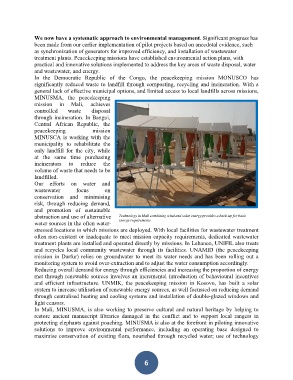
               abstraction and use of alternative   Technology in Mali combining wind and solar energy provides a back-up for basic
               water sources in the often water-   energy requirements
               stressed locations in which missions are deployed. With local facilities for wastewater treatment
               often non-existent or inadequate to meet mission capacity requirements, dedicated wastewater
               treatment plants are installed and operated directly by missions. In Lebanon, UNIFIL also treats
               and  recycles  local  community  wastewater  through  its  facilities.  UNAMID  (the  peacekeeping
               mission  in  Darfur)  relies  on  groundwater  to  meet  its  water  needs  and  has  been  rolling  out  a
               monitoring system to avoid over-extraction and to adjust the water consumption accordingly.
               Reducing overall demand for energy through efficiencies and increasing the proportion of energy
               met through renewable sources involves an incremental introduction of behavioural incentives
               and  efficient  infrastructure.  UNMIK,  the  peacekeeping  mission  in  Kosovo,  has  built  a  solar
               system to increase utilisation of renewable energy sources, as well focussed on reducing demand
               through centralised heating and cooling systems and installation of double-glazed windows and
               light censors.
               In  Mali,  MINUSMA,  is  also  working  to  preserve  cultural  and  natural  heritage  by  helping  to
               restore  ancient  manuscript  libraries  damaged  in  the  conflict  and  to  support  local  rangers  in
               protecting elephants against poaching. MINUSMA is also at the forefront in piloting innovative
               solutions  to  improve  environmental  performance,  including  an  operating  base  designed  to
               maximise conservation of existing flora, nourished through recycled water; use of technology


                                                             6

