


Page 11 - Coespu 2018-4
P. 11
has  ensured  strict  enforcement,  infrastructure  investment,  and  enhanced  tourism.  Though  not
               quite self-sustaining, it is “on the right track.”
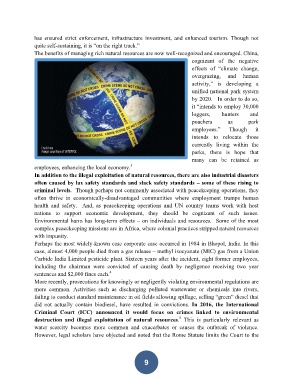
               The benefits of managing rich natural resources are now well-recognized and encouraged. China,
                                                                                 cognizant  of  the  negative
                                                                                 effects  of  “climate  change,
                                                                                 overgrazing,  and  human
                                                                                 activity,”  is  developing  a
                                                                                 unified national park system
                                                                                 by 2020.   In order to do so,
                                                                                 it “intends to employ 30,000
                                                                                 loggers,     hunters     and
                                                                                 poachers       as       park
                                                                                 employees.”     Though     it
                                                                                 intends  to  relocate  those
                                                                                 currently  living  within  the
                                                                                 parks,  there  is  hope  that
                                                                                 many  can  be  retained  as
                                                        3
               employees, enhancing the local economy.
               In addition to the illegal exploitation of natural resources, there are also industrial disasters
               often caused by lax safety standards and slack safety standards – some of these rising to
               criminal levels.  Though perhaps not commonly associated with peacekeeping operations, they
               often  thrive  in  economically-disadvantaged  communities  where  employment  trumps  human
               health  and  safety.    And,  as  peacekeeping  operations  and  UN  country  teams  work  with  host
               nations  to  support  economic  development,  they  should  be  cognizant  of  such  issues.
               Environmental harm has long-term effects – on individuals and resources.  Some of the most
               complex peacekeeping missions are in Africa, where colonial practices stripped natural resources
               with impunity.
               Perhaps the most widely-known case corporate case occurred in 1984 in Bhopol, India. In this
               case, almost 4,000 people died from a gas release – methyl isocyanate (MIC) gas from a Union
               Carbide India Limited pesticide plant. Sixteen years after the incident, eight former employees,
               including  the  chairman  were  convicted  of  causing  death  by  negligence  receiving  two  year
                                               4
               sentences and $2,000 fines each.
               More recently, prosecutions for knowingly or negligently violating environmental regulations are
               more  common.  Activities  such  as  discharging  polluted  wastewater  or  chemicals  into  rivers,
               failing to conduct standard maintenance in oil fields allowing spillage, selling “green” diesel that
               did  not  actually  contain  biodiesel,  have  resulted  in  convictions.  In  2016,  the  International
               Criminal  Court  (ICC)  announced  it  would  focus  on  crimes  linked  to  environmental
                                                                            5
               destruction  and  illegal  exploitation  of  natural  resources.   This  is  particularly  relevant  as
               water  scarcity  becomes  more  common  and  exacerbates  or  causes  the  outbreak  of  violence.
               However, legal scholars have objected and noted that the Rome Statute limits the Court to the


                                                             9

