


Page 23 - Coespu 2018-3
P. 23
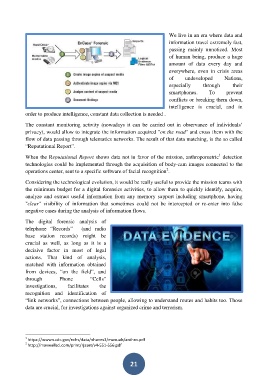
We live in an era where data and
                                                                            information travel extremely fast,
                                                                            passing  mainly  unnoticed.  Most
                                                                            of human being, produce a huge
                                                                            amount  of  data  every  day  and
                                                                            everywhere,  even  in  crisis  areas
                                                                            of     undeveloped       Nations,
                                                                            especially     through      their
                                                                            smartphones.      To      prevent
                                                                            conflicts or breaking them down,
                                                                            intelligence  is  crucial,  and  in
            order to produce intelligence, constant data collection is needed .

            The  constant  monitoring  activity  (nowadays  it  can  be  carried  out  in  observance  of  individuals’
            privacy), would allow to integrate the information acquired "on the road" and cross them with the
            flow of data passing through telematics networks. The result of that data matching, is the so called
            “Reputational Report”.

                                                                                                  1
            When the Reputational Report shows data not in favor of the mission, anthropometric  detection
            technologies could be implemented through the acquisition of body-cam images connected to the
                                                                           2
            operations center, sent to a specific software of facial recognition .

            Considering the technological evolution, it would be really useful to provide the mission teams with
            the minimum budget for a digital forensics activities, to allow them to quickly identify, acquire,
            analyze  and  extract  useful  information  from  any  memory  support  including  smartphone,  having
            "clear"  visibility  of  information  that  sometimes  could  not  be  intercepted  or  re-enter  into  false
            negative cases during the analysis of information flows.

            The  digital  forensic  analysis  of
            telephone  “Records”    (and  radio
            base  station  records)  might  be
            crucial  as  well,  as  long  as  it  is  a
            decisive  factor  in  most  of  legal
            actions.  That  kind  of  analysis,
            matched  with  information  obtained
            from  devices,  “on  the  field”,  and
            through        Phone         “Cells”
            investigations,    facilitates   the
            recognition  and  identification  of
            “link networks”, connections between people, allowing to understand routes and habits too. Those
            data are crucial, for investigations against organized crime and terrorism.


            1
              https://wwwn.cdc.gov/nchs/data/nhanes3/manuals/anthro.pdf
            2
              http://maxwellsci.com/print/rjaset/v4-551-556.pdf


                                                           21

