


Page 22 - Coespu 2018-3
P. 22
PEACEKEEPING 2.0 – POSSIBLE ROLE OF DIGITAL


                      TECHNOLOGYES AND DIGITAL FORENSIC ACTIVITIES

               By Luigi NICOTERA.


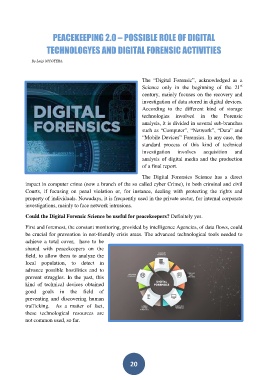
                                                                The  “Digital  Forensic”,  acknowledged  as  a
                                                                                                            st
                                                                Science  only  in  the  beginning  of  the  21
                                                                century,  mainly  focuses  on  the  recovery  and
                                                                investigation of data stored in digital devices.
                                                                According  to  the  different  kind  of  storage
                                                                technologies  involved  in  the  Forensic
                                                                analysis, it is divided in several sub-branches
                                                                such as “Computer”, “Network”, “Data” and
                                                                “Mobile Devices” Forensics. In any case, the
                                                                standard  process  of  this  kind  of  technical
                                                                investigation   involves   acquisition   and
                                                                analysis  of  digital  media  and  the  production
                                                                of a final report.
                                                                The  Digital  Forensics  Science  has  a  direct
            impact in computer crime (now a branch of the so called cyber Crime), in both criminal and civil
            Courts,  if  focusing  on  penal  violation  or,  for  instance,  dealing  with  protecting  the  rights  and
            property of individuals. Nowadays, it is frequently used in the private sector, for internal corporate
            investigations, mainly to face network intrusions.

            Could the Digital Forensic Science be useful for peacekeepers? Definitely yes.

            First and foremost, the constant monitoring, provided by intelligence Agencies, of data flows, could
            be crucial for prevention in not-friendly crisis areas. The advanced technological tools needed to
            achieve  a  total  cover,    have  to  be
            shared  with  peacekeepers  on  the
            field,  to  allow  them  to analyze  the
            local  population,  to  detect  in
            advance  possible  hostilities  and  to
            prevent  struggles.  In  the  past,  this
            kind  of  technical  devices  obtained
            good  goals  in  the  field  of
            preventing  and  discovering  human
            trafficking.    As  a  matter  of  fact,
            these  technological  resources  are
            not common used, so far.


                                                           20

