


Page 8 - Coespu Magazine 2018-2
P. 8
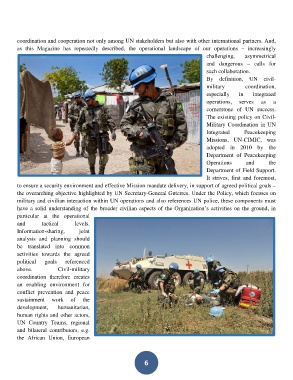
coordination and cooperation not only among UN stakeholders but also with other international partners. And,
        as  this  Magazine  has  repeatedly  described,  the  operational  landscape  of  our  operations  –  increasingly
                                                                                       challenging,    asymmetrical
                                                                                       and  dangerous  –  calls  for
                                                                                       such collaboration.
                                                                                       By  definition,  UN  civil-
                                                                                       military        coordination,
                                                                                       especially    in    integrated
                                                                                       operations,   serves   as   a
                                                                                       cornerstone  of  UN  success.
                                                                                       The existing policy on Civil-
                                                                                       Military  Coordination  in  UN
                                                                                       Integrated      Peacekeeping
                                                                                       Missions,  UN-CIMIC,  was
                                                                                       adopted  in  2010  by  the
                                                                                       Department  of  Peacekeeping
                                                                                       Operations       and      the
                                                                                       Department of Field Support.
                                                                                       It  strives,  first  and  foremost,
        to ensure a security environment and effective Mission mandate delivery, in support of agreed political goals –
        the overarching objective highlighted by UN Secretary-General Guterres. Under the Policy, which focuses on
        military and civilian interaction within UN operations and also references UN police, these components must
        have  a  solid  understanding  of  the  broader  civilian  aspects  of  the  Organization’s  activities  on  the  ground,  in
        particular  at  the  operational
        and       tactical      levels.
        Information-sharing,      joint
        analysis  and  planning  should
        be  translated  into  common
        activities  towards  the  agreed
        political   goals   referenced
        above.           Civil-military
        coordination  therefore  creates
        an  enabling  environment  for
        conflict  prevention  and  peace
        sustainment  work  of  the
        development,     humanitarian,
        human rights and other actors,
        UN  Country  Teams,  regional
        and  bilateral  contributors,  e.g.
        the  African  Union,  European


                                                             6

