


Page 11 - Coespu Magazine 2018-2
P. 11
mentor and advise host States, their security bodies, but also jointly participate in broader institutions building,
        empowering parliamentarians, women and youths, civil society organizations. All of this again require a very
        close  coordination  and  cooperation  among  the  UN  assistance  providers  and  national  authorities.  In  Côte
        d’Ivoire,  UNOCI  police,  together  with  others,  contributed  to  the  resolution  of  post-electoral  problems  and
        helped  renew  trust  in  the  Ivorian  police;  while  in  the  Central  African  Republic,  the  security  sector  reform
        component and UN Police are critical in assisting the creation of national security forces and their deployment
        to the countryside. In Haiti and several other operations, UN police components – together with Interpol, the
        Office on Drugs and Crime and UN Development Programme - participate in the establishment of national anti-
        organized crime units.
        UN  Peacekeeping  turned  70  this  year.  Over  this  time,  practices  and  challenges  to  peace  have  evolved
        considerably,  as  have  the  crucial  UN-CIMIC  efforts.  The  above  clearly  indicates  how  much  UN-CIMIC
        coordination has evolved and expanded in recent years, building on best practices in various operations. Yet,
        much more needs to be done to strengthen the protection of civilians, enhance conflict prevention and peace
        sustainment. While DPKO and DFS, together with partners, have been tasked by Secretary-General Guterres to
        enhance these crucial activities, the time has also come to review the existing UN-CIMIC Policy, bringing it in
        line with new realities. Obviously, this would mean the need to delineate more precise responsibilities, address
        command and control structures, decision-making processes, information management, identify resources and
        more. DPKO’ Office for Rule of Law and Security Sector Institutions and its Police Division should become a
        major stakeholder in such a new CIMIC guidance. Other UN partners could also be actively involved so as to
        create a truly integrated, system-wide approach.


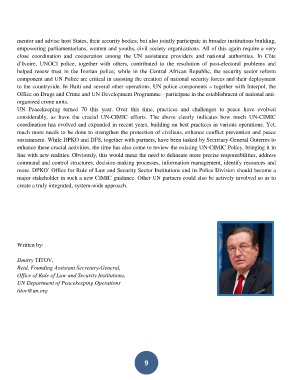
        Written by:

        Dmitry TITOV,
        Retd, Founding Assistant Secretary-General,
        Office of Rule of Law and Security Institutions,
        UN Department of Peacekeeping Operations
        titov@un.org


                                                             9

