


Page 45 - Coespu Magazine 2018-2
P. 45
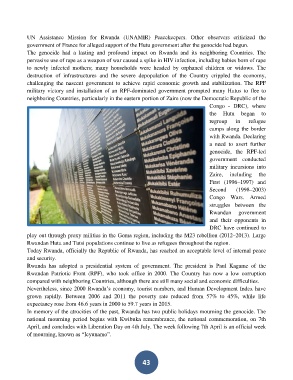
UN  Assistance  Mission  for  Rwanda  (UNAMIR)  Peacekeepers.  Other  observers  criticized  the
            government of France for alleged support of the Hutu government after the genocide had begun.
            The  genocide  had  a  lasting  and  profound  impact  on  Rwanda  and  its  neighboring  Countries.  The
            pervasive use of rape as a weapon of war caused a spike in HIV infection, including babies born of rape
            to  newly  infected  mothers;  many  households  were  headed  by  orphaned  children  or  widows.  The
            destruction  of  infrastructures  and  the  severe  depopulation  of  the  Country  crippled  the  economy,
            challenging  the  nascent  government  to  achieve  rapid  economic  growth  and  stabilization.  The  RPF
            military  victory  and  installation  of  an  RPF-dominated  government  prompted  many  Hutus  to  flee  to
            neighboring Countries, particularly in the eastern portion of Zaire (now the Democratic Republic of the
                                                                                         Congo  -  DRC),  where
                                                                                         the  Hutu  began  to
                                                                                         regroup   in    refugee
                                                                                         camps  along  the  border
                                                                                         with Rwanda. Declaring
                                                                                         a  need  to  avert  further
                                                                                         genocide,  the  RPF-led
                                                                                         government  conducted
                                                                                         military  incursions  into
                                                                                         Zaire,  including  the
                                                                                         First  (1996–1997)  and
                                                                                         Second     (1998–2003)
                                                                                         Congo  Wars.  Armed
                                                                                         struggles  between  the
                                                                                         Rwandan     government
                                                                                         and  their  opponents  in
                                                                                         DRC have continued to
            play out through proxy militias in the Goma region, including the M23 rebellion (2012–2013). Large
            Rwandan Hutu and Tutsi populations continue to live as refugees throughout the region.
            Today Rwanda, officially the Republic of Rwanda, has reached an acceptable level of internal peace
            and security.
            Rwanda  has  adopted  a  presidential  system  of  government.  The  president  is  Paul  Kagame  of  the
            Rwandan  Patriotic  Front  (RPF),  who  took  office  in  2000.  The  Country  has  now  a  low  corruption
            compared with neighboring Countries, although there are still many social and economic difficulties.
            Nevertheless, since 2000 Rwanda’s economy, tourist numbers, and Human Development Index have
            grown  rapidly.  Between  2006  and  2011  the  poverty  rate  reduced  from  57%  to  45%,  while  life
            expectancy rose from 46.6 years in 2000 to 59.7 years in 2015.
            In memory of the atrocities of the past, Rwanda has two public holidays mourning the genocide. The
            national  mourning  period  begins  with  Kwibuka  remembrance,  the  national  commemoration,  on  7th
            April, and concludes with Liberation Day on 4th July. The week following 7th April is an official week
            of mourning, known as “Icyunamo”.


                                                             43

