


Page 43 - Coespu Magazine 2018-2
P. 43
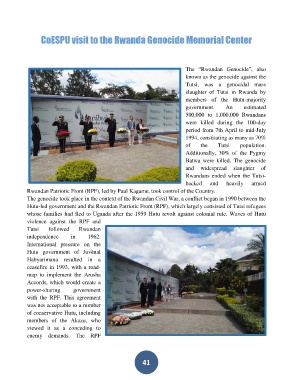
CoESPU visit to the Rwanda Genocide Memorial Center


                                                                               The  “Rwandan  Genocide”,  also
                                                                               known as the genocide against the
                                                                               Tutsi,  was  a  genocidal  mass
                                                                               slaughter  of  Tutsi  in  Rwanda  by
                                                                               members  of  the  Hutu-majority
                                                                               government.     An      estimated
                                                                               500,000  to  1,000,000  Rwandans
                                                                               were  killed  during  the  100-day
                                                                               period from 7th April to mid-July
                                                                               1994, constituting as many as 70%
                                                                               of    the    Tutsi    population.
                                                                               Additionally,  30%  of  the  Pygmy
                                                                               Batwa  were  killed.  The  genocide
                                                                               and  widespread  slaughter  of
                                                                               Rwandans  ended  when  the  Tutsi-
                                                                               backed    and    heavily   armed
            Rwandan Patriotic Front (RPF), led by Paul Kagame, took control of the Country.
            The genocide took place in the context of the Rwandan Civil War, a conflict began in 1990 between the
            Hutu-led government and the Rwandan Patriotic Front (RPF), which largely consisted of Tutsi refugees
            whose families had fled to Uganda after the 1959 Hutu revolt against colonial rule. Waves of Hutu
            violence  against  the  RPF  and
            Tutsi    followed     Rwandan
            independence       in     1962.
            International  pressure  on  the
            Hutu  government  of  Juvènal
            Habyarimana  resulted  in  a
            ceasefire in 1993, with a road-
            map  to  implement  the  Arusha
            Accords, which would create a
            power-sharing       government
            with  the  RPF.  This  agreement
            was not acceptable to a number
            of conservative Hutu, including
            members  of  the  Akazu,  who
            viewed  it  as  a  conceding  to
            enemy  demands.  The  RPF


                                                             41

