


Page 18 - Coespu Magazine 2018-2
P. 18
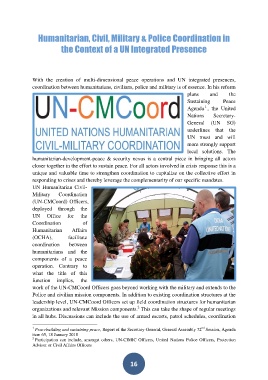
Humanitarian, Civil, Military & Police Coordination in
                            the Context of a UN Integrated Presence


               With  the  creation  of  multi-dimensional  peace  operations  and  UN  integrated  presences,
               coordination between humanitarians, civilians, police and military is of essence. In his reform
                                                                                    plans     and      the
                                                                                    Sustaining      Peace
                                                                                            1
                                                                                    Agenda ,  the  United
                                                                                    Nations     Secretary-
                                                                                    General  (UN  SG)
                                                                                    underlines  that  the
                                                                                    UN  must  and  will
                                                                                    more strongly support
                                                                                    local  solutions.  The
               humanitarian-development-peace  &  security  nexus  is  a  central  piece  in  bringing  all  actors
               closer together in the effort to sustain peace. For all actors involved in crisis response this is a
               unique and valuable time to strengthen coordination to capitalize on the collective effort in
               responding to crises and thereby leverage the complementarity of our specific mandates.
               UN  Humanitarian  Civil-
               Military    Coordination
               (UN-CMCoord) Officers,
               deployed  through  the
               UN     Office   for   the
               Coordination           of
               Humanitarian      Affairs
               (OCHA),         facilitate
               coordination     between
               humanitarians  and  the
               components  of  a  peace
               operation.  Contrary  to
               what  the  title  of  this
               function  implies,  the
               work of the UN-CMCoord Officers goes beyond working with the military and extends to the
               Police and civilian mission components. In addition to existing coordination structures at the
               leadership level, UN-CMCoord Officers set up field coordination structures for humanitarian
                                                              2
               organizations and relevant Mission components.  This can take the shape of regular meetings
               in all hubs. Discussions can include the use of armed escorts, patrol schedules, coordination

               1                                                                           nd
                 Peacebuilding and sustaining peace, Report of the Secretary-General, General Assembly 72  Session, Agenda
               item 65, 18 January 2018
               2
                 Participation  can  include,  amongst  others,  UN-CIMIC  Officers,  United  Nations  Police  Officers,  Protection
               Advisor or Civil Affairs Officers


                                                           16

