


Page 34 - CoESPU Magazine 2017-3
P. 34
it has been stood out a rising influence and integration of the International Human Rights principles on
            IHL. The IIHL with its initiative highlighted that Gender Violence, whilst still prevalent in many armed
            conflicts, does not appear to be widely addressed in traditional IHL training packages for the armed
            forces. The issue assumes also more and more relevance if we consider the growing number of women
            involved in the battlefield, either in regular and non-state armed forces.
            The subject itself covers a wide a range of behaviors not all of which amount to breaches of IHL, but
            ranging from individual criminal conduct by, for instance, peacekeepers, to its systematic employment
            as a means and method of warfare.
            The UN Security Council Resolution 1325, which acknowledged that men and women are affected by
            armed  conflict  and  destabilization  in  a  very  different  way,  was  issued  in  2000  and  since  then  the
            international community has pledged to prevent and protect women and support them to play an active
            role  in  the  post-conflict  reconstruction  processes.  At  the  same  time,  unfortunately,  comparable
            improvements haven't been implemented  with regard to the real conflict situations, where the latest
            normative  provisions  recognizing  some  form  of  "special  protection"  for  these  primarily  affected
            categories goes back to the 1977 Additional Protocols.
                                                                                        The  spirit  of  the
                                                                                        interventions      by
                                                                                        speakers          and
                                                                                        participants  has  been,
                                                                                                    however,
                                                                                        encouraging,      and
                                                                                        there  is  hope  that  the
                                                                                        IHL  provisions  will
                                                                                        be, in the near future,
                                                                                        further  reformed  and
                                                                                        the  SGBV  in  conflict
                                                                                        will  be  recognized  as
                                                                                        relevant  as  other  key
                                                                                        pillars   such     as
                                                                                        distinction       and
                                                                                        precaution are today.

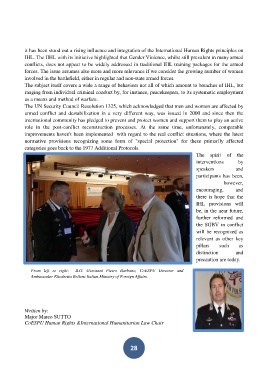
               From  left  to  right:    B.G.  Giovanni  Pietro  Barbano,  CoESPU  Director  and

               Ambassador Elisabetta Belloni Italian Ministry of Foreign Affairs.


            Written by:
            Major Marco SUTTO
            CoESPU Human Rights &International Humanitarian Law Chair


                                                           28

