


Page 32 - CoESPU Magazine 2017-3
P. 32
composed  by  experts  of  international  level,  discussed  the  most  relevant  current  issues  such  as
            deprivation  of  individual  freedom  in  armed  conflict,  sexual  and  gender  violence,  medical  staff
            protection  and  humanitarian
            negotiations.
            The  contributions  by  the
            institutional  representatives  in
            the  forefront  in the  study  and
            protection  of  human  rights
            were also  greatly appreciated;
            among  these  the  French
            Defense      Ministry,    the
            International  Red  Cross,  the
            International  Criminal  Court,
            the Colombian Representation
            to the United Nations and the
            Italian      Inter-Ministerial
            Commission      on    Human
            Rights.
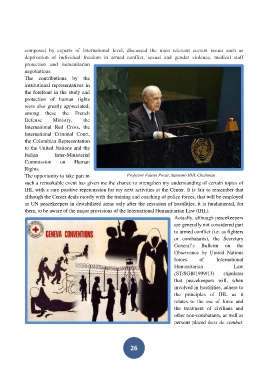
            The opportunity to take part in                           Professor Fausto Pocar, Sanremo IIHL Chairman
            such a remarkable event has given me the chance to strengthen my understanding of certain topics of
            IHL with a sure positive repercussion for my next activities at the Center. It is fair to remember that
            although the Center deals mostly with the training and coaching of police forces, that will be employed
            as UN peacekeepers in destabilized areas only after the cessation of hostilities, it is fundamental, for
            them, to be aware of the major provisions of the International Humanitarian Law (IHL).
                                                                              Actually, although peacekeepers
                                                                              are generally not considered part
                                                                              to armed conflict (i.e. as fighters
                                                                              or  combatants),  the  Secretary
                                                                              General’s   Bulletin   on   the
                                                                              Observance  by  United  Nations
                                                                              forces      of     International
                                                                              Humanitarian               Law
                                                                              (ST/SGB/1999/13)      stipulates
                                                                              that  peacekeepers  will,  when
                                                                              involved in hostilities, adhere to
                                                                              the  principles  of  IHL  as  it
                                                                              relates  to  the  use  of  force  and
                                                                              the  treatment  of  civilians  and
                                                                              other non-combatants, as well as
                                                                              persons placed hors de combat.


                                                           26

