


Page 55 - Coespu Magazine 2017-2
P. 55
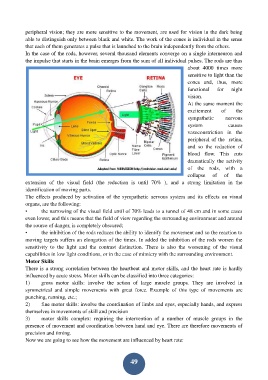
peripheral vision; they are more sensitive to the movement, are used for vision in the dark being
            able to distinguish only between black and white. The work of the cones is individual in the sense
            that each of them generates a pulse that is launched to the brain independently from the others.
            In the case of the rods, however, several thousand elements converge on a single interneuron and
            the impulse that starts in the brain emerges from the sum of all individual pulses. The rods are thus
                                                                                    about  4000  times  more
                                                                                    sensitive to light than the
                                                                                    cones  and,  thus,  more
                                                                                    functional    for   night
                                                                                    vision.
                                                                                    At the same moment the
                                                                                    excitement     of     the
                                                                                    sympathetic      nervous
                                                                                    system            causes
                                                                                    vasoconstriction  in  the
                                                                                    peripheral of the  retina,
                                                                                    and  so  the  reduction  of
                                                                                    blood  flow.  This  cuts
                                                                                    dramatically  the  activity
                                                                                    of  the  rods,  with  a
                                                                                    collapse   of    of   the
            extension  of  the  visual  field  (the  reduction  is  until  70%  ),  and  a  strong  limitation  in  the
            identification of moving parts.
            The  effects  produced  by  activation  of  the  sympathetic  nervous  system  and  its  effects  on  visual
            organs, are the following:
            •      the narrowing of the visual field until of 70% leads to a tunnel of 48 cm and in some cases
            even lower, and this means that the field of view regarding the surrounding environment and around
            the source of danger, is completely obscured;
            •      the inhibition of the rods reduces the ability to identify the movement and so the reaction to
            moving targets suffers an elongation of the times. In added the inhibition of the rods worsen the
            sensitivity  to  the  light  and  the  contrast  distinction.  There  is  also  the  worsening  of  the  visual
            capabilities in low light conditions, or in the case of mimicry with the surrounding environment.
            Motor Skills
            There is a strong correlation between the heartbeat and motor skills, and the heart rate is hardly
            influenced by acute stress. Motor skills can be classified into three categories:
            1)     gross  motor  skills:  involve  the  action  of  large  muscle  groups.  They  are  involved  in
            symmetrical  and  simple  movements  with  great  force.  Example  of  this  type  of  movements  are
            punching, running, etc.;
            2)     fine motor skills: involve the coordination of limbs and eyes, especially hands, and express
            themselves in movements of skill and precision
            3)     motor  skills  complex:  requiring  the  intervention  of  a  number  of  muscle  groups  in  the
            presence of movement and coordination between hand and eye. There are therefore movements of
            precision and timing.
            Now we are going to see how the movement are influenced by heart rate:


                                                           49

