


Page 51 - Coespu Magazine 2017-2
P. 51
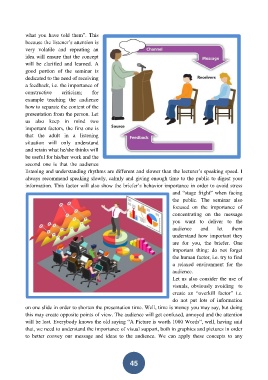
what  you  have  told  them”.  This
            because the listener’s attention is
            very  volatile  and  repeating  an
            idea will ensure that the concept
            will  be  clarified  and  learned.  A
            good  portion  of  the  seminar  is
            dedicated to the need of receiving
            a feedback, i.e. the importance of
            constructive     criticism;   for
            example  teaching  the  audience
            how to separate the content of the
            presentation from the person. Let
            us  also  keep  in  mind  two
            important factors, the first one is
            that  the  adult  in  a  listening
            situation  will  only  understand
            and retain what he/she thinks will
            be useful for his/her work and the
            second  one  is  that  the  audience
            listening and understanding rhythms are different and slower than the lecturer’s speaking speed. I
            always recommend speaking slowly, calmly and giving enough time to the public to digest your
            information. This factor will also show the briefer’s behavior importance in order to avoid stress
                                                                              and  “stage  fright”  when  facing
                                                                              the  public.  The  seminar  also
                                                                              focused  on  the  importance  of
                                                                              concentrating  on  the  message
                                                                              you  want  to  deliver  to  the
                                                                              audience    and     let   them
                                                                              understand  how  important  they
                                                                              are  for  you,  the  briefer.  One
                                                                              important  thing:  do  not  forget
                                                                              the human factor, i.e. try to find
                                                                              a  relaxed  environment  for  the
                                                                              audience.
                                                                              Let us  also consider the use of
                                                                              visuals,  obviously  avoiding    to
                                                                              create  an  “overkill  factor”  i.e.
                                                                              do  not  put  lots  of  information
            on one slide in order to shorten the presentation time. Well, time is money you may say, but doing
            this may create opposite points of view. The audience will get confused, annoyed and the attention
            will be lost. Everybody knows the old saying “A Picture is worth 1000 Words”, well, having said
            that, we need to understand the importance of visual support, both in graphics and pictures in order
            to  better  convey  our  message  and  ideas  to  the  audience.  We  can  apply  these  concepts  to  any


                                                           45

