


Page 54 - Coespu Magazine 2017-2
P. 54
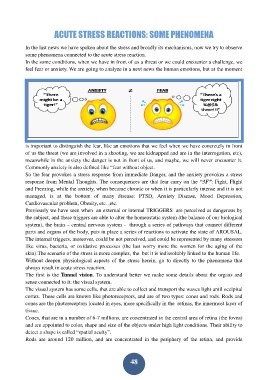
ACUTE STRESS REACTIONS: SOME PHENOMENA


            In the last news we have spoken about the stress and broadly its mechanisms, now we try to observe
            some phenomena connected to the acute stress reaction.
            In the some conditions, when we have in front of us a threat or we could encounter a challenge, we
            feel fear or anxiety. We are going to analyze in a next news the human emotions, but at the moment


            is important to distinguish the fear, like an emotions that we feel when we have concretely in front
            of us the threat (we are involved in a shooting, we are kidnapped and are in the interrogation, etc),
            meanwhile in the anxiety the danger is not in front of us, and maybe, we will never encounter it.
            Commonly anxiety is also defined like “fear without object.
            So the fear provokes a stress response from immediate Danger, and the anxiety provokes a stress
            response from Mental Thoughts. The consequences are that fear carry on the “3F”: Fight, Flight
            and Freezing, while the anxiety, when became chronic or when it is particularly intense and it is not
            managed,  is  at  the  bottom  of  many  disease:  PTSD,  Anxiety  Disease,  Mood  Depression,
            Cardiovascular problem, Obesity, etc. ,etc.
            Previously we have seen when  an external or internal TRIGGERS  are perceived as dangerous by
            the subject, and these triggers are able to alter the homeostatic system (the balance of our biological
            system), the brain – central nervous system -  through a series of pathways that connect different
            parts and organs of the body, puts in place a series of reactions to activate the state of AROUSAL.
            The internal triggers, moreover, could be not perceived, and could be represented by many stressors
            like virus, bacteria, or oxidative processes (the last  worry more the  women for the aging of the
            skin).The scenario of the stress is more complex, the  but it is indissolubly linked to the human life.
            Without  deepen  physiological  aspects  of  the  stress  herein,  go  to  directly  to  the  phenomena  that
            always result in acute stress reaction.
            The first is the Tunnel vision. To understand better we make some details about the organs and
            sense connected to it: the visual system.
            The visual system has some cells, that are able to collect and transport the waves light until occipital
            cortex. These cells are known like photoreceptors, and are of two types: cones and rods. Rods and
            cones are the photoreceptors located in eyes, more specifically in the  retinas, the innermost layer of
            tissue.
            Cones, that are in a number of 6-7 millions, are concentrated in the central area of retina (the fovea)
            and are appointed to color, shape and size of the objects under high light conditions. Their ability to
            detect a shape is called “spatial acuity”.
            Rods  are  around  120  million,  and  are  concentrated  in  the  periphery  of  the  retina,  and  provide


                                                           48

