


Page 17 - Coespu Magazine 2017-2
P. 17
injured or harmed, are civilians.
            In 2000, the so-called “Brahimi Report”, and the corresponding United Nations Security Council
            Resolution  1327,  recommended  that  peace  operations  be  given  clear,  credible  and  achievable
            mandates and, where appropriate and within their mandates, a credible deterrent capability. Those
            documents  further  recommended  that  the  mandated  tasks  be  appropriate  to  the  situation  on  the
            ground, including the potential need to protect civilians. In particular the Brahimi Report stressed
            the relevance of capability of each potential troop contributor to meet the requisite United Nations
            training and to have the equipment requirements for peacekeeping operations, prior to deployment.
            At the same time the UNSC Resolution 1327 emphasized  the importance for the Member States to
            take the necessary and appropriate steps to ensure the capability of their peacekeepers to fulfil the
            mandates assigned to them, underlining the importance of international cooperation in this regard,
            including the training of the peacekeepers.
            Since these first steps, the United Nations Security Council has increasingly focused on responding
            to  PoC  challenges:  accordingly,  the  Council  has  provided  the  missions  with  tougher  and  more
            specific       mandates,
            including the support for
            a robust peacekeeping as
            a   means     to   protect
            civilians,  and  mandates
            have become much more
            focused  on  protecting
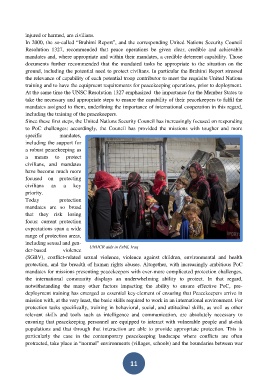
 Indonesian peacekeepers in South Sudan
            civilians   as   a    key
            priority.
            Today          protection
            mandates  are  so  broad
            that  they  risk  losing
            focus:  current  protection
            expectations span a wide
            range of protection areas,
            including sexual and gen-    UNHCR aids in Erbil, Iraq
            der-based        violence
            (SGBV),  conflict-related  sexual  violence,  violence  against  children,  environmental  and  health
            protection, and the breadth of human rights abuses. Altogether, with increasingly ambitious PoC
            mandates for missions presenting peacekeepers with ever-more complicated protection challenges,
            the  international  community  displays  an  underwhelming  ability  to  protect.  In  that  regard,
            notwithstanding  the  many  other  factors  impacting  the  ability  to  ensure  effective  PoC,  pre-
            deployment training has emerged as essential key-element of ensuring that Peacekeepers arrive in
            mission with, at the very least, the basic skills required to work in an international environment. For
            protection tasks specifically, training in behavioral, social, and attitudinal skills, as well as other
            relevant  skills  and  tools  such  as  intelligence  and  communication,  are  absolutely  necessary  to
            ensuring that peacekeeping personnel are equipped to interact with vulnerable people and at-risk
            populations  and  that  through  that  interaction  are  able  to  provide  appropriate  protection.  This  is
            particularly  the  case  in  the  contemporary  peacekeeping  landscape  where  conflicts  are  often
            protracted, take place in “normal” environments (villages, schools) and the boundaries between war


                                                           11

