


Page 15 - Coespu Magazine 2017-2
P. 15
PROTECTION OF CIVILIANS


            According  to  the  Geneva  Conventions  of  1949  and  the  related  Additional  Protocols  of  1977,
            civilians and all persons not taking part in combat may under no circumstances be the object of
            attack and must be spared and protected: for the first time the Protection of Civilians (PoC)  was
            afforded  to  all  civilians  caught  up  in  armed  conflicts,  and  the  Protocols  included  enhanced
                                                                               obligations  on  parties  to  the
                                                                               conflict to provide the essential
                                                                               needs  for  the  survival  of  the
                                                                               civilians  population,  including
                                                                               humanitarian           access,
                                                                               protection  of  humanitarian
                                                                               relief  workers  and  a  general
                                                                               prohibition on starvation.
                                                                               Despite the development of the
                                                                               law    and    the   protection
                                                                               provided by the law, in reality
            civilians have been increasingly targeted throughout human history. It is estimated that one out of
            ten casualties in the First World War was a civilian. By the Second World War, this number had
            increased up to five out of ten casualties. Today the estimation has increased to nine out of ten
            casualties: a very impressive number.


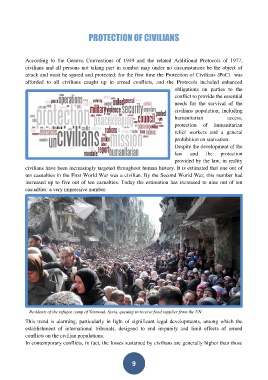
              Residents of the refugee camp of Yarmouk, Syria, queuing to receive food supplies from the UN
            This  trend  is  alarming,  particularly  in  light  of  significant  legal  developments,  among  which  the
            establishment  of  international  tribunals,  designed  to  end  impunity  and  limit  effects  of  armed
            conflicts on the civilian populations.
            In contemporary conflicts, in fact, the losses sustained by civilians are generally higher than those


                                                            9

