


Page 221 - La Grande Guerra dei Carabinieri
P. 221
221
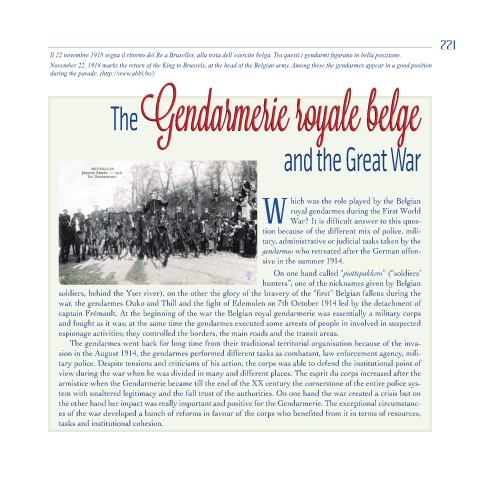
              Il 22 novembre 1918 segna il ritorno del Re a Bruxelles, alla testa dell’esercito belga. Tra questi i gendarmi figurano in bella posizione.
              November 22, 1918 marks the return of the King to Brussels, at the head of the Belgian army. Among these the gendarmes appear in a good position
              during the parade. (http://www.abbl.be/)


                              The Gendarmerie royale belge
                                      Gendarmerie royale belge


                                                                           and the Great War


                                                                             hich was the role played by the Belgian
                                                                             royal gendarmes during the First World
                                                                     W War? It is difficult answer to this ques-
                                                                     tion because of the different mix of police, mili-
                                                                     tary, administrative or judicial tasks taken by the
                                                                     gendarmes who retreated after the German offen-
                                                                     sive in the summer 1914.
                                                                        On one hand called “piottepakkers” (“soldiers’
                                                                     hunters”, one of the nicknames given by Belgian
                soldiers, behind the Yser river), on the other the glory of the bravery of the “first” Belgian fallens during the
                war, the gendarmes Ouko and Thill and the fight of Edemolen on 7th October 1914 led by the detachment of
                captain Frémault. At the beginning of the war the Belgian royal gendarmerie was essentially a military corps
                and fought as it was; at the same time the gendarmes executed some arrests of people in involved in suspected
                espionage activities; they controlled the borders, the main roads and the transit areas.
                   The gendarmes went back for long time from their traditional territorial organisation because of the inva-
                sion in the August 1914, the gendarmes performed different tasks as combatant, law enforcement agency, mili-
                tary police. Despite tensions and criticisms of his action, the corps was able to defend the institutional point of
                view during the war when he was divided in many and different places. The esprit du corps increased after the
                armistice when the Gendarmerie became till the end of the XX century the cornerstone of the entire police sys-
                tem with unaltered legitimacy and the full trust of the authorities. On one hand the war created a crisis but on
                the other hand her impact was really important and positive for the Gendarmerie. The exceptional circumstanc-
                es of the war developed a bunch of reforms in favour of the corps who benefited from it in terms of resources,
                tasks and institutional cohesion.

