


Page 21 - Coespu 2020-1
P. 21
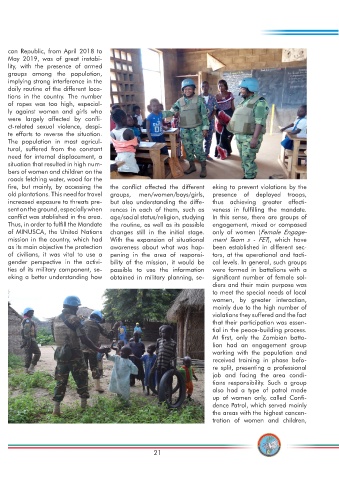
can Republic, from April 2018 to
    May  2019,  was  of  great  instabi-
    lity, with the presence  of armed
    groups  among the population,
    implying strong interference in the
    daily routine of the different loca-
    tions  in  the  country.  The  number
    of rapes was too  high, especial-
    ly  against women and  girls who
    were  largely  affected  by  confli-
    ct-related sexual  violence,  despi-
    te  efforts  to  reverse  the  situation.
    The population in  most agricul-
    tural, suffered from the constant
    need for internal displacement, a
    situation that resulted in high num-
    bers of women and children on the
    roads fetching water, wood for the
    fire,  but  mainly,  by  accessing  the  the  conflict  affected  the  different  eking to prevent violations by the
    old plantations. This need for travel  groups,  men/women/boys/girls,  presence  of deployed troops,
    increased exposure to threats pre-  but  also understanding the diffe-  thus achieving greater effecti-
    sent on the ground, especially when  rences  in each of them, such as  veness  in  fulfilling  the  mandate.
    conflict was stablished in the area.  age/social status/religion, studying  In this sense, there are groups of
    Thus, in order to fulfill the Mandate  the routine, as well as its possible  engagement, mixed or composed
    of MINUSCA, the United Nations  changes  still  in  the  initial  stage.  only  of  women  (Female  Engage-
    mission in the country, which had  With  the  expansion  of  situational  ment  Team  s  -  FET),  which have
    as its main objective the protection  awareness  about what was hap-    been established in different sec-
    of civilians,  it was vital  to use a  pening in the area  of  responsi-  tors, at the operational and tacti-
    gender perspective  in the activi-  bility of the mission, it would be  cal levels. In general, such groups
    ties of its military component, se-  possible to use the information  were formed in battalions with a
    eking a better understanding how  obtained in military planning, se-    significant  number  of  female  sol-
                                                                            diers and their main purpose was
                                                                            to meet the special needs of local
                                                                            women, by greater interaction,
                                                                            mainly due to the high number of
                                                                            violations they suffered and the fact
                                                                            that their participation was essen-
                                                                            tial in the peace-building process.
                                                                            At  first,  only  the  Zambian  batta-
                                                                            lion had  an engagement group
                                                                            working with  the population  and
                                                                            received  training in phase befo-
                                                                            re split, presenting a professional
                                                                            job and facing the area condi-
                                                                            tions  responsibility.  Such  a  group
                                                                            also had a type of patrol made
                                                                            up  of  women  only,  called  Confi-
                                                                            dence Patrol, which served mainly
                                                                            the areas with the highest concen-
                                                                            tration  of women and children,


                                                       21

