


Page 31 - Coespu 2018-3
P. 31
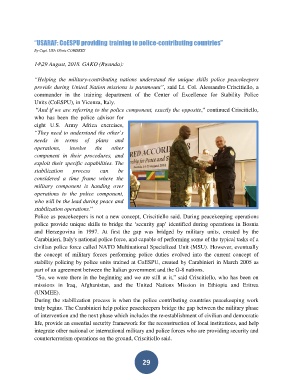
“USARAF: CoESPU providing training to police-contributing countries”
               By Capt. USA Olivia COBISKEY

               14\29 August, 2018. GAKO (Rwanda):

               “Helping  the  military-contributing  nations  understand  the  unique  skills  police  peacekeepers
               provide during United Nation missions is paramount”, said Lt. Col. Alessandro Criscitiello, a
               commander  in  the  training  department  of  the  Center  of  Excellence  for  Stability  Police
               Units (CoESPU), in Vicenza, Italy.
                “And if we are referring to the police component, exactly the opposite,” continued Criscitiello,
               who  has  been  the  police  advisor  for
               eight  U.S.  Army  Africa  exercises,
               “They need to understand the other’s
               needs  in  terms  of  plans  and
               operations,    involve    the    other
               component  in  their  procedures,  and
               exploit their specific capabilities. The
               stabilization   process     can    be
               considered  a  time  frame  where  the
               military  component  is  handing  over
               operations  to  the  police  component,
               who will be the lead during peace and
               stabilization operations.”
               Police as peacekeepers is not a new concept, Criscitiello said. During peacekeeping operations
               police provide unique skills to bridge the ‘security gap’ identified during operations in Bosnia
               and  Herzegovina  in  1997.  At  first  the  gap  was  bridged  by  military  units,  created  by  the
               Carabinieri, Italy's national police force, and capable of performing some of the typical tasks of a
               civilian police force called NATO Multinational Specialized Unit (MSU). However, eventually
               the  concept  of  military  forces  performing  police  duties  evolved  into  the  current  concept  of
               stability policing by police units trained at CoESPU, created by Carabinieri in March 2005 as
               part of an agreement between the Italian government and the G-8 nations.
                “So, we were there in the beginning and we are still at it,” said Criscitiello, who has been on
               missions  in  Iraq,  Afghanistan,  and  the  United  Nations  Mission  in  Ethiopia  and  Eritrea
               (UNMEE).
               During  the  stabilization  process  is  when  the  police  contributing  countries  peacekeeping  work
               truly begins. The Carabinieri help police peacekeepers bridge the gap between the military phase
               of intervention and the next phase which includes the re-establishment of civilian and democratic
               life, provide an essential security framework for the reconstruction of local institutions, and help
               integrate other national or international military and police forces who are providing security and
               counterterrorism operations on the ground, Criscitiello said.


                                                             29

