


Page 25 - Coespu Magazine 2018-2
P. 25
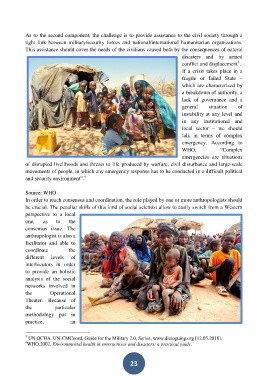
As to the second component, the challenge is to provide assistance to the civil society through a
            tight  link  between  military/security  forces  and  national/international  humanitarian  organizations.
            This assistance should cover the needs of the civilians caused both by the consequences of natural
                                                                                  disasters  and  by  armed
                                                                                                           3
                                                                                  conflict and displacement .
                                                                                  If  a  crisis  takes  place  in  a
                                                                                  fragile  or  failed  State  –
                                                                                  which  are  characterized  by
                                                                                  a breakdown of authority, a
                                                                                  lack  of  governance  and  a
                                                                                  general     situation    of
                                                                                  instability  at  any  level  and
                                                                                  in  any  institutional  and
                                                                                  local  sector  –  we  should
                                                                                  talk  in  terms  of  complex
                                                                                  emergency.  According  to
                                                                                  WHO,             “Complex
                                                                                  emergencies  are  situations
            of disrupted livelihoods and threats to life produced by warfare, civil disturbance and large-scale
            movements of people, in which any emergency response has to be conducted in a difficult political
                                      4
            and security environment”.

            Source: WHO
            In order to reach consensus and coordination, the role played by one or more anthropologists should
            be crucial. The peculiar skills of this kind of social scientist allow to easily switch from a Western
            perspective  to  a  local
            one,    as    to    the
            consensus  issue.  The
            anthropologist is also a
            facilitator  and  able  to
            coordinate          the
            different   levels   of
            interlocutors  in  order
            to  provide  an  holistic
            analysis  of  the  social
            networks  involved  in
            the        Operational
            Theater.  Because  of
            the          particular
            methodology  put  in
            practice,           an


            3
              UN OCHA, UN-CMCoord, Guide for the Military 2.0, Series, www.dialoguing.org [12.05.2018].
            4
             WHO.2002. Environmental health in emergencies and disasters: a practical guide.


                                                           23

