


Page 55 - The CoESPU Magazine N 1 - 2018
P. 55
•      use of chemical substances
            Results very important to consider these variables not only when we take a care of patients, but also
            when we are employed in military or sport training.
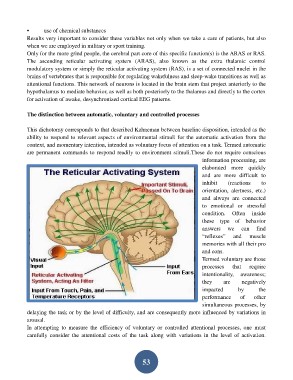
            Only for the more grind people, the cerebral part core of this specific function(s) is the ARAS or RAS.
            The  ascending  reticular  activating  system  (ARAS),  also  known  as  the  extra  thalamic  control
            modulatory system or simply the reticular activating system (RAS), is a set of connected nuclei in the
            brains of vertebrates that is responsible for regulating wakefulness and sleep-wake transitions as well as
            attentional functions. This network of neurons is located in the brain stem that project anteriorly to the
            hypothalamus to mediate behavior, as well as both posteriorly to the thalamus and directly to the cortex
            for activation of awake, desynchronized cortical EEG patterns.

            The distinction between automatic, voluntary and controlled processes

            This dichotomy corresponds to that described Kahneman between baseline disposition, intended as the
            ability to respond to relevant aspects of environmental stimuli for the automatic activation from the
            context, and momentary intention, intended as voluntary focus of attention on a task. Termed automatic
            are  permanent  commands  to  respond  readily  to  environment  stimuli.These  do  not  require  conscious
                                                                                      information processing, are
                                                                                      elaborated  more  quickly
                                                                                      and  are  more  difficult  to
                                                                                      inhibit   (reactions    to
                                                                                      orientation,  alertness,  etc.)
                                                                                      and  always  are  connected
                                                                                      to  emotional  or  stressful
                                                                                      condition.  Often  inside
                                                                                      these  type  of  behavior
                                                                                      answers  we  can  find
                                                                                      “reflexes”   and   muscle
                                                                                      memories with all their pro
                                                                                      and cons.
                                                                                      Termed voluntary are those
                                                                                      processes   that   require
                                                                                      intentionality,  awareness;
                                                                                      they    are     negatively
                                                                                      impacted       by      the
                                                                                      performance    of    other
                                                                                      simultaneous processes, by
            delaying the task or by the level of difficulty, and are consequently more influenced by variations in
            arousal.
            In  attempting  to  measure  the  efficiency  of  voluntary  or  controlled  attentional  processes,  one  must
            carefully  consider  the  attentional  costs  of  the  task  along  with  variations  in  the  level  of  activation.


                                                             53

