


Page 60 - Supplemento 2-2016 (ENG)
P. 60
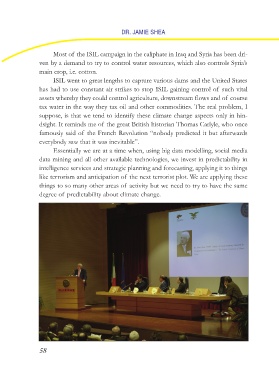
dr. Jamie shea

      Most of the ISIL campaign in the caliphate in Iraq and Syria has been dri-
ven by a demand to try to control water resources, which also controls Syria’s
main crop, i.e. cotton.

      ISIL went to great lengths to capture various dams and the United States
has had to use constant air strikes to stop ISIL gaining control of such vital
assets whereby they could control agriculture, downstream flows and of course
tax water in the way they tax oil and other commodities. The real problem, I
suppose, is that we tend to identify these climate change aspects only in hin-
dsight. It reminds me of the great British historian Thomas Carlyle, who once
famously said of the French Revolution “nobody predicted it but afterwards
everybody saw that it was inevitable”.

      Essentially we are at a time when, using big data modelling, social media
data mining and all other available technologies, we invest in predictability in
intelligence services and strategic planning and forecasting, applying it to things
like terrorism and anticipation of the next terrorist plot. We are applying these
things to so many other areas of activity but we need to try to have the same
degree of predictability about climate change.

58

