


Page 44 - The CoESPU Magazine N 1 - 2018
P. 44
1907  Great  Peasant  Revolt,  the  Rumanian  Gendarmerie  is  reorganized  by  new  laws  in
            1908, 1911 and 1913.
            During the Second Balkan war in 1913, and then during the World War I, the Gendarmerie
            ensures  the  fast  mobilization  of  the  Rumanian  army  and  was  in  charge  for  guarantees
                                                                                military  police  activities,
                                                                                borders  police  tasks  and
                                                                                the     surveillance       of
                                                                                important           military
                                                                                installations.  It  organizes
                                                                                the  evacuation  during  the
                                                                                1916  retreat  and  its  forces
                                                                                was  also  committed  in
                                                                                combats  during  the  1917
                                                                                campaign.  Then  supervise
                                                                                the  demobilization  of  the
                                                                                Army  in  July  1918,  the
                                                                                remobilization  in  October
                                                                                1918  and  the  maintenance
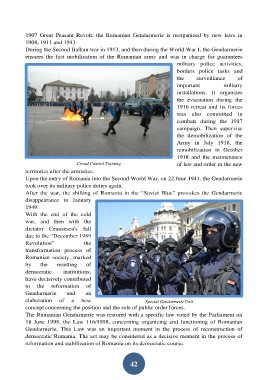
                                   Crowd Control Training                       of law and order in the new
            territories after the armistice.
            Upon the entry of Romania into the Second World War, on 22 June 1941, the Gendarmerie
            took over its military police duties again.
            After  the  war,  the  shifting  of  Romania  in  the  “Soviet  Bloc”  provokes  the  Gendarmerie
            disappearance  in  January
            1949.
            With  the  end  of  the  cold
            war,  and  then  with  the
            dictator  Ceausescu's  fall
            due to the “December 1989
            Revolution”               the
            transformation  process  of
            Romanian  society,  marked
            by     the    resetting    of
            democratic       institutions,
            have decisively contributed
            to   the    reformation    of
            Gendarmerie        and     an
            elaboration    of    a   new                          Special Gendarmerie Unit
            concept concerning the position and the role of public order forces.
            The Rumanian Gendarmerie was restored with a specific law voted by the Parliament on
            18  June  1998,  the  Law  116/1998,  concerning  organizing  and  functioning  of  Romanian
            Gendarmerie.  This  Law  was  an  important  moment  in  the  process  of  reconstruction  of
            democratic Romania. The act may be considered as a decisive moment in the process of
            reformation and stabilization of Romania on its democratic course.


                                                           42

