


Page 64 - CoESPU Magazine 2017-3
P. 64
Beginning  in  1953,  the
            exhibition   explores    the
            fundamental     stages    of
            Zeffirelli's         zealous
            international  career,  made
            all the more exciting by the
            intense  friendships  he  often
            had    with   his   greatest
            collaborators.   First   and
            foremost,   Maria    Callas,
            who,  under  the  direction  of
            Zeffirelli,       performed
            masterpieces    by    Verdi,
            Puccini, Bellini, Rossini and
            Donizetti.        Alongside
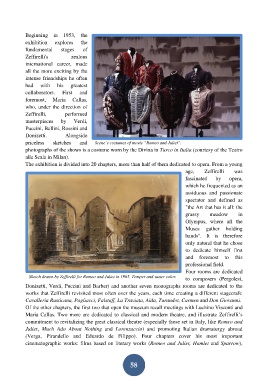
            priceless   sketches    and    Scene’s costumes of movie “Romeo and Juliet”.
            photographs of the shows is a costume worn by the Divina in Turco in Italia (courtesy of the Teatro
            alla Scala in Milan).
            The exhibition is divided into 20 chapters, more than half of them dedicated to opera. From a young
                                                                                   age,     Zeffirelli   was
                                                                                   fascinated    by    opera,
                                                                                   which he frequented as an
                                                                                   assiduous  and  passionate
                                                                                   spectator  and  defined  as
                                                                                   "the Art that has it all: the
                                                                                   grassy     meadow       in
                                                                                   Olympus,  where  all  the
                                                                                   Muses  gather  holding
                                                                                   hands".  It  is  therefore
                                                                                   only natural that he chose
                                                                                   to  dedicate  himself  first
                                                                                   and  foremost  to  this
                                                                                   professional field.
                                                                                   Four rooms are dedicated
              Sketch drawn by Zeffirelli for Romeo and Juliet in 1965. Temper and water color.
                                                                                   to  composers  (Pergolesi,
            Donizetti, Verdi, Puccini and Barber) and another seven monographs rooms are dedicated to the
            works that Zeffirelli revisited most often over the years, each time creating a different stagecraft:
            Cavalleria Rusticana, Pagliacci, Falstaff, La Traviata, Aida, Turandot, Carmen and Don Giovanni.
            Of the other chapters, the first two that open the museum recall meetings with Luchino Visconti and
            Maria  Callas.  Two  more  are  dedicated  to  classical  and  modern  theatre,  and  illustrate  Zeffirelli’s
            commitment to revitalizing the great classical theatre (especially those set in Italy, like Romeo and
            Juliet,  Much  Ado  About  Nothing  and  Lorenzaccio)  and  promoting  Italian  dramaturgy  abroad
            (Verga,  Pirandello  and  Eduardo  de  Filippo).  Four  chapters  cover  his  most  important
            cinematographic works: films based on literary  works (Romeo and Juliet, Hamlet and Sparrow),


                                                           58

